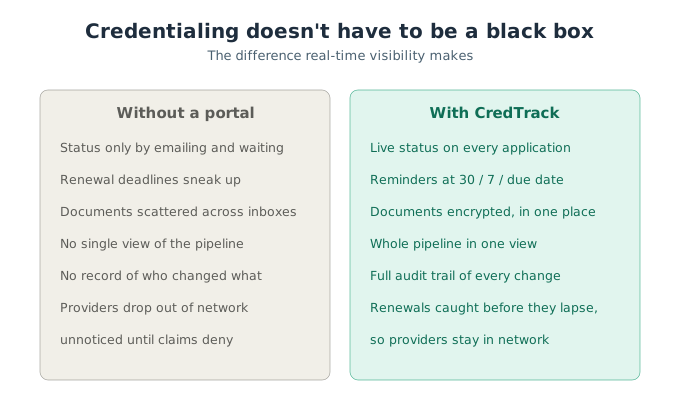
Credentialing is usually a black box. You submit applications, hand off documents, and then wait, with no clear view of where anything stands. The only way to get an update is to email someone and ask, then wait again for a reply. Renewal deadlines sneak up because nobody’s watching them centrally. Documents live scattered across inboxes. And when you finally do get a status, it’s a snapshot that’s already out of date.
That lack of visibility isn’t just frustrating. It’s expensive. When no one has a clear, current picture of every application and every upcoming renewal, deadlines slip, applications stall on missing paperwork, and providers fall out of network without anyone noticing until claims start denying.
We built CredTrack to close that gap. It’s a real-time credentialing portal that gives every MedBillingTech credentialing client live access to exactly where their credentialing stands, at no extra cost today. This post explains the visibility problem CredTrack solves, what real-time credentialing tracking should actually look like, and how the portal works.
Why Credentialing Is So Hard to See Into
Credentialing is uniquely opaque compared to most business processes, for a few structural reasons.
It’s slow and multi-staged. A single application moves through document collection, submission, payer review, development letters, and approval, often over 90 to 120 days. At any given moment, a provider might have several applications with several payers, each at a different stage. Holding that entire picture in your head, or in a spreadsheet, is nearly impossible.
It’s deadline-dense. Every provider has licenses, malpractice coverage, DEA registrations, and CAQH attestations, each with its own expiration date, each requiring renewal on its own cycle. A ten-provider group can easily have dozens of moving deadlines across the year. Miss one and the provider can drop out of network, which is one of the quiet, avoidable causes of lost revenue we covered in our guide to what credentialing delays actually cost.
It’s document-heavy. Missing or expired paperwork is the single most common reason applications stall, the same failure pattern behind many credentialing application denials. When documents are scattered across email threads, keeping them current and complete is a constant scramble.
Put those together and you get a process that’s almost impossible to see clearly without a system built specifically to track it. That’s the gap CredTrack fills.
What Real-Time Credentialing Tracking Should Look Like
Before getting into how CredTrack works, it’s worth defining what good visibility actually means. A credentialing portal should answer four questions instantly, without anyone having to send an email:
Where does every application stand right now? Not last week’s status, but the current state of each enrollment, and what’s needed next.
What’s coming up for renewal? A forward view of every expiring credential, early enough to renew before anything lapses.
Are our records current and complete? A clear picture of which documents are on file, which are missing, and which are about to expire.
Who changed what, and when? An accountable history, so nothing happens to sensitive credentialing data without a record.
Most practices can’t answer these questions on demand today. CredTrack is built so you can answer all four the moment you log in.
See your credentialing in real time
Book a quick walkthrough and we’ll show you CredTrack feature by feature, then map it to your practice:
How CredTrack Works
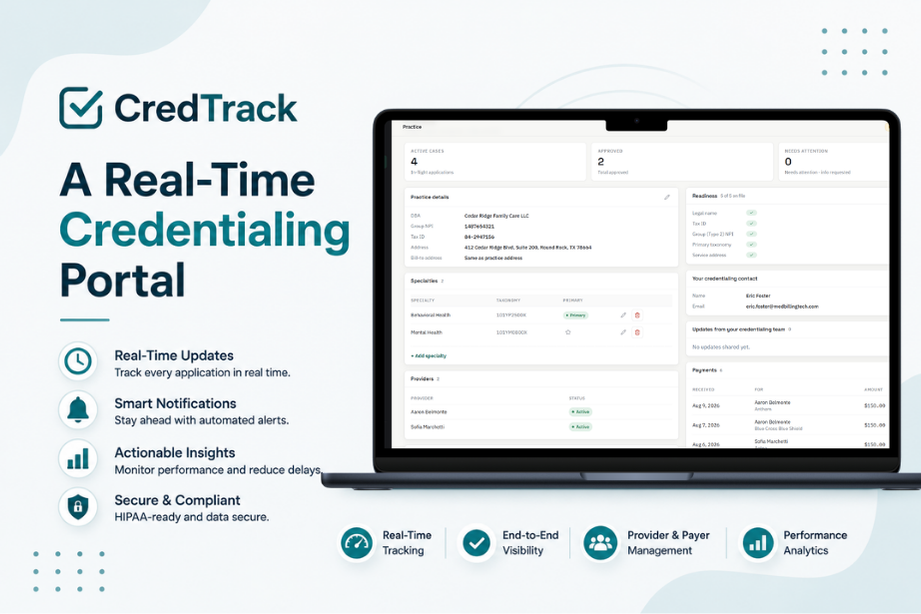
CredTrack organizes credentialing into a single, always-current view. Rather than walk through every screen, here’s what it does, grouped by the problem each part solves.
See where everything stands. The dashboard opens to a live overview of your credentialing: active cases, recent approvals, your providers, and applications, all on one screen. Open any individual application to see its exact status and the per-payer document checklist tracked item by item, so you can see what’s done and what’s still outstanding before submission. A pipeline view shows every application across all your providers at once, sortable and filterable, replacing the status-call-and-spreadsheet routine with a picture that’s always current.
Never miss a renewal. CredTrack keeps a forward view of every credential coming up for renewal, with a simple readiness indicator showing whether each provider has their core credentials current. It emails you when a license, malpractice policy, or CAQH re-attestation is coming due, at 30 days, at 7 days, and on the date itself. Renew early and the cycle resets. The reminders can be toggled per practice, so you control the flow. For CAQH specifically, this directly addresses the 120-day attestation lapse that trips up so many practices, as detailed in our CAQH ProView profile guide, and it reinforces the renewal discipline covered in our re-credentialing deadline guide.
Keep every record current and in one place. Each provider gets a full profile: licenses, NPI, CAQH, malpractice, specialties, and documents. You can update something yourself when you renew it, or send it to your credentialing team, and notes from the team appear right in the profile so context lives where you need it. Credentialing documents, W-9s, licenses, certificates, are stored in one secure, encrypted place instead of scattered across email.
Stay accountable. Every status change, edit, payment, and update is recorded with who made it and when, giving you a complete, attributable history. Payments are itemized per application, so there’s never guesswork about what’s been billed. Nothing happens without a record.
The Difference: Visibility Plus a Team Doing the Work
There’s an important distinction here. CredTrack is not standalone credentialing software you have to run yourself.
We’ve written before about the real difference between credentialing software and a credentialing service: software is a tool that makes a knowledgeable person faster, while a service supplies the expertise and does the work. Standalone credentialing software still leaves you to actually do the credentialing.
CredTrack gives you the best of both. Our team does the credentialing work, the submissions, the payer follow-up, the development-letter responses, and CredTrack gives you the real-time visibility into that work that you’d normally only get from running software yourself. You get the transparency of a portal and a team handling the actual credentialing, without paying for either separately. Right now, CredTrack is included with every MedBillingTech credentialing engagement at no additional cost.
Built for Sensitive Data
Credentialing files contain Social Security numbers, license numbers, and personal history, so the portal is built with the security discipline that sensitive data demands.
Access is role-based and scoped, so you see only your own practice’s information, private to you, enforced at every layer. Documents are stored and transmitted securely under HIPAA-aligned protocols, backed by a signed BAA before any data is exchanged. Every action is captured in the audit log. And your provider data is used only to do your credentialing, never sold, never shared, and deleted on request.
Frequently Asked Questions
CredTrack is a real-time credentialing portal that gives MedBillingTech credentialing clients live visibility into their credentialing. You can see where every application stands, track upcoming renewals, store documents securely, and view a full audit trail, all from one portal accessible on any device. It comes free with every MedBillingTech credentialing engagement.
Currently, CredTrack is included at no additional cost with every MedBillingTech credentialing engagement. It’s a visibility layer on top of the credentialing work our team already does for you, not a separate software subscription you pay for or have to run yourself.
No. Unlike standalone credentialing software, which leaves you to do the actual credentialing, CredTrack pairs real-time visibility with a team that does the credentialing work for you. You get the transparency of a portal and done-for-you credentialing together, rather than choosing between them.
CredTrack keeps a forward view of every credential coming up for renewal and emails you at 30 days, 7 days, and on the due date for licenses, malpractice policies, and CAQH re-attestations. Renew early and the cycle resets. This helps prevent the lapsed credentials that can drop a provider out of network and cause claim denials. Reminders can be turned on or off per practice.
Yes. CredTrack uses role-based access so you see only your own practice’s data, stores and transmits documents under HIPAA-aligned protocols backed by a signed BAA, and records every action in a complete audit trail. Your data is never sold or shared and is deleted on request.
See Your Credentialing in Real Time
Credentialing doesn’t have to be a black box. With CredTrack, you always know where every application stands, what’s coming up for renewal, and that every record is current and secure, without sending a single “any update?” email.
CredTrack is currently included with every MedBillingTech credentialing engagement. Our team handles the credentialing work, submissions, payer follow-up, renewals, and you get real-time visibility into all of it. Flat fee of $150 per application, portal included. Sixteen-plus years of payer enrollment experience across all 50 states.
See CredTrack and Book a Walkthrough →
If you want to know where your credentialing stands today before getting started, the free CredReady audit reviews your enrollment posture across all major payers in 15 minutes.
Or call (307) 243 2190 to see the portal for yourself.