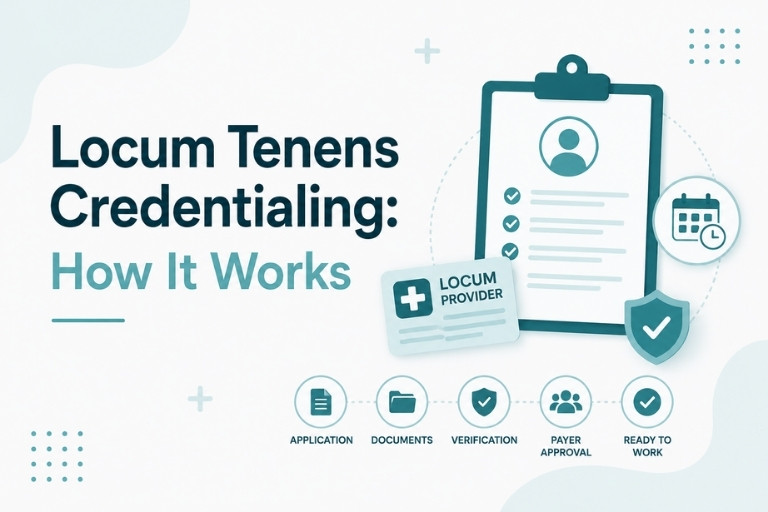
Locum tenens credentialing works differently from standard credentialing because a locum provider usually bills under the absent physician’s identity, not their own. When a practice brings in a temporary physician to cover for a doctor who’s on vacation, on leave, or recently departed, Medicare lets the practice bill those services under the regular physician’s NPI with a special modifier, rather than requiring the locum to be fully credentialed and enrolled first. That’s the whole point of the arrangement: it keeps the schedule covered and the revenue flowing without waiting out a 90-day credentialing cycle.
But the arrangement comes with a specific set of rules, and getting them wrong turns a convenient coverage solution into denied claims, overpayment liability, and audit exposure. The 60-day limit, the Q6 modifier, documentation requirements, exclusion screening, and the wide variation in how commercial payers handle all of this each have to be managed correctly, every time.
This post explains how locum tenens credentialing and billing actually work, what the rules require, and where practices get into trouble.
What Locum Tenens Actually Means
A locum tenens provider is a physician who temporarily takes over another physician’s practice during an absence, with the regular physician billing and receiving payment for the substitute’s services as if they performed them. The Latin phrase means “holding the place,” which is exactly the function: the locum holds the absent physician’s place on the schedule.
One terminology note worth knowing. CMS has formally discontinued the term “locum tenens” in its manuals, replacing it with “fee-for-time compensation arrangements”, a change tied to the 21st Century Cures Act. The regulations themselves didn’t change, and the industry still universally says “locum tenens,” but on official CMS documentation you’ll see the fee-for-time language.
Locums are used for exactly the situations you’d expect: a physician on vacation, out on maternity leave, away for continuing medical education, on extended sick leave, or recently departed from the practice with a permanent replacement not yet hired. The substitute physician often has no practice of their own and moves from assignment to assignment as needed.
Why Locum Credentialing Is Different
The defining feature of locum tenens is that the substitute physician generally does not need to be separately credentialed and enrolled with Medicare before seeing patients, because the practice bills under the absent physician’s identity. This is what makes locums fast and useful. Standard credentialing takes 90 to 120 days, as our credentialing timeline guide lays out, and a practice covering a two-week absence can’t wait that long.
Instead of full enrollment, Medicare requires the locum to meet a lighter set of conditions: an active, unrestricted license in the state of practice, a valid NPI, and no exclusion from federal healthcare programs. The practice then bills the locum’s services under the regular physician’s NPI with the Q6 modifier appended, signaling that a substitute under a fee-for-time arrangement provided the service.
This is fundamentally different from the situation where a practice hires a permanent provider. A permanent hire has to go through the full credentialing and enrollment process, and billing under someone else’s NPI while waiting for that to complete is not a locum arrangement. It’s a compliance violation. The locum structure exists specifically for genuine temporary coverage, not as a workaround for slow credentialing.
The Rules That Govern Locum Billing
Several specific requirements make a locum arrangement compliant. Missing any one of them can turn paid claims into recoupable overpayments.
The Q6 modifier. The regular physician identifies the substitute’s services by entering HCPCS modifier Q6 after the procedure code. The claim goes out under the regular physician’s NPI (and the group NPI where applicable), with Q6 signaling the fee-for-time arrangement.
The 60-day limit. This is the rule practices most often break, and in our experience it breaks the same way every time: the regular physician’s leave runs long, the locum keeps working, and nobody restarts the clock or switches the billing, so everything past day 60 quietly becomes recoupable. If a substitute physician provides services over a continuous period longer than 60 days, the regular physician may bill only the first 60 days with Q6, and the substitute must bill the remainder under their own name. The continuous period runs from the locum’s first day of service until the regular physician returns, and it counts calendar days whether or not the locum sees patients every day. A new 60-day period can begin only after the regular physician has returned to work. The main exception is for physicians called to active military duty, where the 60-day limit is waived.
Fee-for-time compensation. The locum must be paid on a per-diem or fee-for-time basis, not a salary or productivity-based model. A revenue-based payment arrangement violates what defines a temporary substitute physician.
Documentation. The regular physician must keep a record of each service furnished by the substitute, along with the substitute’s NPI, available to Medicare on request. A written agreement capturing the dates, the reason for the absence, the compensation structure, and both providers’ identities is the baseline. The medical record must reflect who actually provided the service, so the substitute should never sign as the absent physician.
Physician-only for Medicare. Under Medicare, services provided by non-physician practitioners such as nurse practitioners and physician assistants generally cannot be billed under fee-for-time compensation arrangements, though some payers treat this differently. Q6 as a Medicare mechanism is built around physicians.
Is credentialing holding up your revenue?
Every day a provider sits uncredentialed is a day you can’t bill for their work. We take the whole process off your plate.
We handle all of it. Flat $150 per application, all 50 states, with clear status on every provider.
Get My Providers Credentialed → or call (307) 243 2190The Exclusion Screening Requirement
One requirement deserves its own emphasis because the liability is severe: every substitute provider must be screened against federal exclusion lists before their first date of service.
An excluded provider cannot participate in a locum arrangement under any billing structure. Claims for services rendered by an excluded provider are subject to recoupment even if the practice didn’t know about the exclusion, and the practice bears liability for those claims regardless. Screening every locum against the OIG exclusion list and SAM.gov before day one is not optional, and it’s the same exclusion-screening discipline that protects against the clawbacks described in our guide to retroactive recoupment for uncredentialed providers.
Where Commercial Payers Complicate Things
The single most dangerous assumption in locum billing is that all payers follow Medicare’s rules. They don’t. Q6 is a Medicare mechanism, and commercial payers vary widely in how they handle substitute providers.
Some commercial payers recognize Q6. Others require a different modifier. Others require the substitute physician to be fully credentialed before seeing any patients, and will deny claims entirely if a temporary provider wasn’t separately credentialed first. Still others require claims billed under the substitute’s own NPI rather than the absent physician’s.
A workflow that’s perfectly compliant under Medicare can violate a commercial payer’s policy and generate denials. The practical defense is to verify each payer’s locum policy before coverage begins, not after claims go out, and to build a payer-specific billing matrix so the billing team knows which rule applies to which payer. This payer-by-payer variation is a recurring theme across credentialing, much like the differences that drive common credentialing denials.
When to Credential Instead of Using a Locum
The 60-day limit is the signal. Locum tenens is designed for genuine temporary coverage, so when an absence stretches past 60 days, or a departed physician is being permanently replaced, the right move is to fully credential and enroll the new provider rather than extend a locum arrangement past its limit.
Practices sometimes try to lean on locum billing to bridge the gap while a permanent provider is credentialed. This is risky. Billing a permanent provider’s services under a locum modifier during their credentialing period is not what the arrangement is for, and it invites audit findings and recoupment. The compliant path is to start the permanent provider’s credentialing early, ideally before their start date, and let the locum cover only the genuine temporary gap. If you’re bringing on a permanent provider, our complete guide to provider credentialing walks through the full enrollment process.
Frequently Asked Questions
For Medicare, generally not in the full sense. A locum provider needs an active unrestricted state license, a valid NPI, and no federal exclusion, but doesn’t need complete Medicare enrollment before seeing patients, because the practice bills under the absent physician’s NPI with the Q6 modifier. Commercial payers vary, and some do require the substitute to be fully credentialed first.
Q6 is the Medicare modifier that identifies services furnished by a substitute physician under a fee-for-time compensation arrangement. The regular physician bills the locum’s services under their own NPI with Q6 appended to the procedure code, signaling that a temporary substitute provided the care while the regular physician was absent.
Medicare allows a practice to bill a substitute physician’s services under the regular physician’s NPI with Q6 for a continuous period of up to 60 days. Beyond 60 continuous days, the substitute must bill under their own name. The period counts calendar days from the locum’s first service date until the regular physician returns, regardless of whether the locum works every day. A new period can start only after the regular physician returns.
Under Medicare’s fee-for-time rules, services by non-physician practitioners such as NPs and PAs generally cannot be billed under locum tenens arrangements, which are built around physicians. Some commercial payers handle NPP substitute arrangements differently, so payer-specific verification is essential before relying on a locum structure for a non-physician.
Generally no. Locum tenens is for genuine temporary coverage, not as a bridge while a permanent hire is credentialed. Billing a permanent provider’s services under a locum modifier during their credentialing period invites audit findings and recoupment. The compliant approach is to start the permanent provider’s credentialing early and use a locum only for a true temporary absence.
Temporary Coverage, Handled Right
Locum tenens is a genuinely useful tool for keeping a practice running through an absence, but it’s a highly scrutinized billing and compliance event, not just a scheduling fix. The 60-day limit, the Q6 modifier, exclusion screening, documentation, and the wide variation among commercial payers all have to be managed correctly to avoid denied claims and recoupment.
Credentialing problems are easier to prevent than to unwind, but only if you can see them before a payer does. The free credentialing audit reviews your enrollment status across every major payer, flags the gaps most likely to stall claims, and gives you a clear picture in about 15 minutes. Take a look at where you stand, or call (307) 243-2190 to talk through your situation.