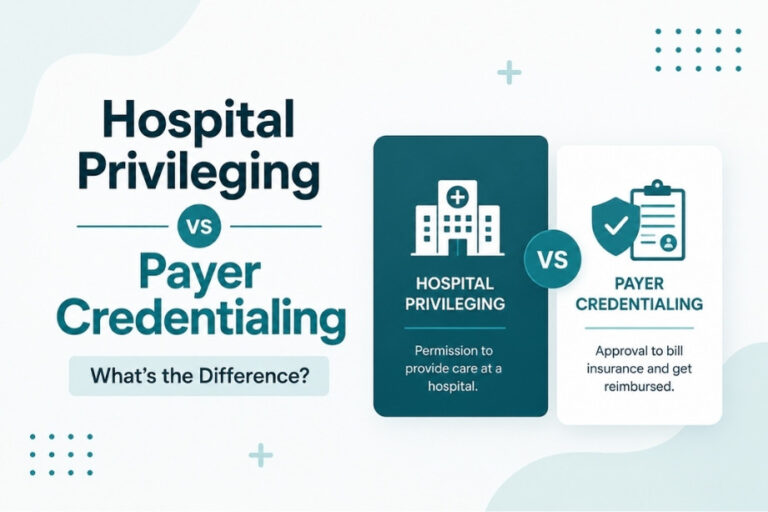
These two get used interchangeably, but they answer completely different questions. Payer credentialing determines whether an insurance company will pay you for treating a patient. Hospital privileging determines whether a specific hospital will let you perform specific procedures on its premises. One is about getting paid. The other is about being allowed to work at a facility. A provider can have one without the other, and confusing them creates gaps that stall a provider’s ability to see patients, bill, or both.
The confusion is understandable because both involve verifying a provider’s qualifications, both run through committees, and both use the word “credentialing” loosely. But they’re separate processes, run by different entities, on different timelines, for different purposes. This post lays out exactly what each one is, how they relate, and why keeping them straight matters.
What Payer Credentialing Is
Payer credentialing is the process an insurance company uses to verify a provider’s qualifications and add them to its network so the provider can bill for services and be reimbursed as in-network. It’s the process most of this blog’s cluster covers, and it’s fundamentally about revenue: until a provider is credentialed and enrolled with a payer, claims for that provider’s services are denied.
Payer credentialing verifies the same core qualifications any credentialing does, license, education, training, board certification, work history, and sanctions, through primary source verification. It applies to essentially every provider who bills insurance, whether they work in a hospital, an outpatient clinic, or a solo office. A family medicine physician who never sets foot in a hospital still needs payer credentialing to bill Aetna, Cigna, Medicare, or any other payer. The full walkthrough of how this process runs is in our complete guide to provider credentialing.
The managing entity is the payer or its delegated credentialing verification organization. The renewal cycle is typically every three years for commercial payers and every five years for Medicare, the re-verification process covered in our re-credentialing deadline guide.
What Hospital Privileging Is
Hospital privileging is the process a hospital or facility uses to authorize a provider to perform specific clinical services on its premises. It answers a narrower, facility-specific question: not “is this provider qualified in general,” but “will we allow this provider to do these particular procedures here.”
Privileging is facility-level and procedure-specific. After a hospital verifies a provider’s baseline qualifications through its own credentialing review, the provider requests a defined set of clinical privileges, the specific procedures, treatments, and activities they want to perform at that facility. The hospital’s medical staff and credentialing committee then evaluate whether the provider has the demonstrated skill and experience for each requested privilege, often including peer review, before granting or denying them.
This is why two providers with identical credentials can end up with different privileges. A hospital might grant one cardiologist privileges to perform cardiac catheterization and deny another the same privilege based on documented case volume and experience. Privileges are earned per procedure, per facility, not conferred automatically by a license or board certification.
There are generally three categories of hospital privileges: admitting privileges (the right to admit patients to the hospital), courtesy privileges (occasional admission or treatment), and surgical privileges (authorization to perform specific surgeries). The hospital board and credentialing committee approve or deny each based on facility policy and demonstrated competency.
The Critical Differences
The two processes diverge on almost every dimension that matters operationally.
Purpose. Payer credentialing is about getting reimbursed. Privileging is about being authorized to work at a facility. One protects revenue; the other grants clinical access.
Managing entity. Payer credentialing is run by insurance companies. Privileging is run by hospitals and facilities. These are entirely separate organizations with separate processes.
Who needs it. Payer credentialing applies to essentially everyone who bills insurance. Privileging applies mainly to providers who work in hospitals and ambulatory surgery centers. Privileging isn’t required for every provider, but it is required for those performing services within a hospital or ASC, so an office-based family physician who doesn’t admit patients generally needs payer credentialing but not hospital privileges.
What it authorizes. Payer credentialing authorizes billing. Privileging authorizes specific clinical procedures at a specific location.
Scope. Payer credentialing is broadly portable in the sense that being credentialed with a payer isn’t tied to one building. Privileges are facility-specific: privileges at one hospital say nothing about another, and a provider working at three hospitals needs privileges at each.
See where your credentialing actually stands
The free credentialing audit checks your enrollment, CAQH, and PECOS posture across every major payer and flags the gaps most likely to be costing you revenue. Takes 15 minutes, no obligation.
Run My Free Audit →How They Relate
Despite their differences, the two processes share a foundation and often run alongside each other. Both start from the same verified credentials, license, education, training, board certification, and both query the National Practitioner Data Bank for malpractice history, license actions, and adverse events. Hospitals are required to query the NPDB when granting or renewing privileges, and payers query it during credentialing. The underlying qualifications being verified are the same; what differs is what each entity does with that verification.
There’s also a sequence within the hospital itself. A hospital first credentials a provider (verifies baseline qualifications) and then privileges them (authorizes specific procedures). Credentialing always comes first; privileging builds on it and never replaces it. This is distinct from payer credentialing, which is a separate track run by the insurer, though it verifies the same underlying facts.
For providers who work in hospitals and bill insurance, all of these have to be complete: payer credentialing to get paid, hospital credentialing and privileging to be allowed to practice at the facility. A gap in any one creates a problem. A surgeon can be fully privileged to operate at a hospital and still unable to bill a payer if payer credentialing lapsed, or fully credentialed with every payer and unable to operate because hospital privileges expired.
Why Confusing Them Is Expensive
Treating these as interchangeable is where practices get into trouble. The version we’re called about most is a surgeon who is privileged and operating while payer enrollment quietly never finished, so months of claims deny before anyone connects the two. Because they have different timelines, different managing entities, and different renewal cycles, assuming “credentialing is handled” can leave a critical gap unaddressed.
A common failure looks like this: a provider joins a practice, payer credentialing gets submitted, and everyone assumes the provider is good to go. But the provider also needs hospital privileges to perform procedures at the affiliated facility, and that separate process never got started, or the temporary privileges granted at the start expired before the full privileging file was complete. The provider is left unable to operate, or operating on lapsed privileges, which carries compliance risk of its own.
The reverse happens too. A provider gets privileged at a hospital and starts seeing patients, but payer credentialing isn’t finished, so every claim denies. This is the same billing-before-enrollment trap that leads to the clawbacks described in our guide to retroactive recoupment for uncredentialed providers.
Keeping the two processes on separate tracked timelines, with separate renewal reminders, is the way to avoid both failure modes. They’re not the same thing, and managing them as if they were is what creates the gaps.
Frequently Asked Questions
Payer credentialing is the process by which an insurance company verifies a provider’s qualifications and adds them to its network so they can bill and be reimbursed. Hospital privileging is the process by which a hospital authorizes a provider to perform specific clinical procedures at that facility. One is about getting paid; the other is about being allowed to work at a specific location.
No. Hospital privileges are required mainly for providers who perform services within a hospital or ambulatory surgery center, such as those who admit patients or perform surgeries. An office-based provider who treats patients only in an outpatient setting and doesn’t admit to a hospital generally needs payer credentialing but not hospital privileges.
Credentialing comes first. Within a hospital, the facility credentials a provider by verifying their baseline qualifications, then privileges them by authorizing specific procedures. Privileging builds on credentialing and never replaces it. Payer credentialing is a separate track run by insurers that verifies the same underlying qualifications for a different purpose.
Yes, and it’s a costly gap. A provider can be fully privileged to perform procedures at a hospital yet unable to bill insurance if payer credentialing isn’t complete, so every claim denies. The reverse also happens: a provider can be credentialed with all payers but unable to operate at a facility because hospital privileges lapsed. Both processes have to be complete and current.
Largely yes. Both processes verify the same baseline qualifications, license, education, training, board certification, and work history, and both query the National Practitioner Data Bank. What differs is what each entity does with that verification: a payer uses it to authorize billing, while a hospital uses it as the foundation for granting facility-specific clinical privileges.
Let us handle your credentialing
Flat fee of $150 per application. Primary source coordination, payer follow-up, and renewal tracking included, across all 50 states, so your providers bill sooner.
Get Started With Credentialing → or call (307) 243 2190Keep Every Track Covered
Hospital privileging and payer credentialing answer different questions, run through different entities, and renew on different schedules. Treating them as one process is how providers end up unable to bill, unable to operate, or both. Managing each on its own tracked timeline is what keeps the gaps from opening.
Credentialing problems are easier to prevent than to unwind, but only if you can see them before a payer does. The free credentialing audit reviews your enrollment status across every major payer, flags the gaps most likely to stall claims, and gives you a clear picture in about 15 minutes. Take a look at where you stand, or call (307) 243-2190 to talk through your situation.