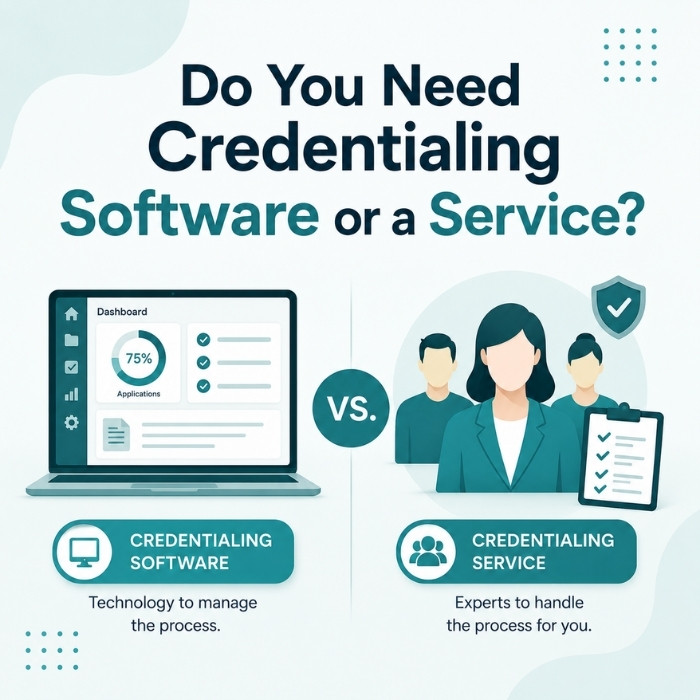
The honest answer is that it depends on one thing more than any other: whether you have the in-house expertise to run credentialing yourself. Credentialing software is a tool that makes a knowledgeable person faster. A credentialing service is a team that supplies the knowledge and does the work. Software assumes you already know how to credential and just need to do it more efficiently. A service assumes you’d rather hand the whole thing off. Buying the wrong one for your situation is how practices end up paying for a platform nobody has time to run, or paying for a service when they had the expertise to do it themselves.
This question comes up constantly for growing practices, and it’s usually framed as a two-way choice when it’s really a three-way one: software, an in-house team (with or without software), or an outsourced service. Each fits a different kind of practice. This post breaks down what each actually does, what each costs, and how to tell which one fits your situation.
What Credentialing Software Actually Does
Credentialing software is a platform that organizes and automates the administrative side of credentialing. It does not do credentialing for you. It gives a person who already knows how to credential a system to do it in, replacing the spreadsheets, file folders, and calendar reminders that most small practices use.
A good credentialing platform typically handles document storage and expiration tracking, so licenses, DEA registrations, and malpractice certificates are logged with renewal alerts. It syncs with CAQH ProView to reduce duplicate data entry and flag the 120-day attestation. It tracks payer applications through each stage from submission to approval. It runs continuous monitoring against OIG exclusion lists and state license databases. And it stores everything in an audit-ready format for accreditation reviews.
What software does not do is know which payer wants which form, call a payer to chase a stalled application, respond to a development letter, or figure out why a specific claim is denying. It automates the tracking. The judgment and the legwork still belong to a person. If you don’t have that person, software is a filing cabinet you’re paying a subscription for.
Software is priced on a subscription basis, and the range is wide depending on features and organization size, from modest per-user monthly fees for smaller platforms to substantial annual licenses for enterprise systems. On top of the license cost, you need someone to administer it, keep it updated, and actually use it every day.
What a Credentialing Service Actually Does
A credentialing service is a team that does the credentialing work for you. Where software is a tool, a service is people plus tools. The vendor handles document collection, primary source verification coordination, payer application submission, follow-up with payers, development letter responses, enrollment confirmation, and ongoing re-credentialing and revalidation tracking.
The core value of a service isn’t the software they use behind the scenes, though good services use enterprise-grade platforms. It’s the expertise. A credentialing service does this work all day, every day, across many payers and states, so they know which payer needs which supplemental form, which state Medicaid program is slow, how to phrase a development letter response, and how to catch the data mismatches that cause the most common credentialing denials before they happen.
Services are typically priced per application or per provider, sometimes with an ongoing maintenance component for attestation and revalidation tracking. This makes the cost scale directly with how much credentialing you actually need, rather than a fixed annual platform fee whether you credential two providers or twenty this year.
The tradeoff people worry about with a service is loss of control and visibility. That’s a fair concern, and it’s the right question to ask any prospective partner: a good service provides more transparency than most in-house operations, with regular reporting on where every application stands. A service that can’t tell you the status of every provider with every payer on request isn’t one worth using.
The Third Option: In-House Team
Between software and an outsourced service sits the option most large organizations choose: an in-house credentialing team, usually equipped with credentialing software.
This is the right model when you have enough steady credentialing volume to justify dedicated staff. A certified credentialing coordinator who knows your payers, your providers, and your systems is a genuine asset, and for a large group or health system with a constant flow of new providers and re-credentialing deadlines, an in-house team with good software is often the most cost-effective and controllable approach.
The catch is what it actually costs. Once salary, benefits, payroll taxes, software licensing, and management oversight are fully accounted for, an in-house credentialing function runs well into the tens of thousands of dollars per year, often $75,000 or more for a single experienced coordinator with tools. That surprises administrators who assume handling it internally is automatically cheaper. And there’s a concentration risk: when your one credentialing coordinator leaves, replacing and training a qualified successor takes months, during which applications stall, revalidation deadlines slip, and providers can fall out of network. The practices that come to us mid-crisis are almost always in exactly this spot: the coordinator gave notice, a stack of revalidations is due, and nobody left knows the payer logins. Many practices discover the fragility of the in-house model only when the person running it gives notice.
How to Decide: The Questions That Actually Matter
The decision comes down to a few honest questions about your practice. The answers point clearly to one of the three models.
Do you have credentialing expertise in-house right now? If yes, software makes that person more efficient. If no, software won’t help, because it doesn’t supply the knowledge. You need a service or you need to hire expertise.
How much credentialing volume do you have? A practice adding one or two providers a year has very different needs than one onboarding a provider a month. Low, sporadic volume favors a service, since you pay for what you use. High, steady volume can justify the fixed cost of an in-house team with software.
What happens if your credentialing person quits tomorrow? If the honest answer is “everything stops,” you have a concentration risk that a service eliminates, because a service is a team, not a single person. This is one of the strongest arguments for outsourcing at small and mid-size practices.
Are you growing or entering new states? Rapid growth and multi-state expansion multiply credentialing complexity fast, as anyone who has worked through multi-state licensing for telehealth knows. A service scales instantly. An in-house team has to hire ahead of the growth, and software still needs someone to run it.
What is credentialing currently costing you in delays? The real cost of credentialing isn’t the tool or the service fee. It’s the revenue lost while providers wait to bill, which our guide on the cost of credentialing delays breaks down. If your current approach is producing delays, the cost of fixing it is almost always smaller than the delays themselves.
Matching the Model to the Practice
The three models map fairly cleanly onto practice size and situation.
Software fits larger in-house teams that already have credentialing expertise and want to work faster, and organizations of 50 or more providers with steady volume and staff to run the platform. If you have the people and the process, software is the efficiency layer on top.
A service fits solo providers and small-to-mid-size groups without dedicated credentialing staff, practices that are growing or entering new states, practices where credentialing expertise is concentrated in one person, and any practice where leadership would rather spend its attention on patient care than on payer paperwork. It’s also the natural fit for specialties with extra complexity, like the carve-out panels and license-type rules in behavioral health credentialing.
An in-house team fits large groups and health systems with high, constant credentialing volume, enough scale to absorb the fixed cost and the turnover risk, and a preference for keeping the function fully under internal control.
Many practices also blend these. A common hybrid is an in-house coordinator using software for day-to-day tracking, with an outsourced service handling overflow during growth spurts or covering the gap when the coordinator leaves. There’s no rule against mixing models to fit your situation.
Why Compliance Raises the Stakes
Whichever model you choose, the compliance bar has risen, and that changes the calculation. Credentialing is governed by NCQA standards that define how organizations verify qualifications and maintain documentation, and accreditation bodies like The Joint Commission require regular credentialing to maintain accreditation status. In 2026, monitoring expectations tightened, with more frequent exclusion-list and sanctions checks and shorter verification windows.
This matters for the software-versus-service decision because staying current with changing standards is itself a job. Software helps you track compliance, but someone still has to know what the current standards are. A service absorbs that burden entirely, keeping up with NCQA, CMS, and state changes as part of what you’re paying for. For a practice without compliance expertise on staff, that’s often the deciding factor.
Is credentialing holding up your revenue?
Every day a provider sits uncredentialed is a day you can’t bill for their work. We take the whole process off your plate.
We handle all of it. Flat $150 per application, all 50 states, with clear status on every provider.
Get My Providers Credentialed → or call (307) 243 2190Frequently Asked Questions
Credentialing software is a tool that helps someone who already knows how to credential do it more efficiently, automating document tracking, CAQH syncing, and application monitoring. A credentialing service is a team that does the credentialing work for you, supplying both the expertise and the labor. Software assumes in-house knowledge; a service supplies it.
It depends on volume and whether you have in-house expertise. Software has a fixed subscription cost but still requires staff time to run it. A service is priced per application or provider, so cost scales with actual need. For low or sporadic volume without dedicated credentialing staff, a service is usually more cost-effective. For high, steady volume with staff already in place, software or an in-house team can cost less per provider.
When it already has credentialing expertise in-house and enough steady volume to justify dedicated staff. Software makes a knowledgeable coordinator faster, so it pays off for larger groups and health systems that have the people and the process and simply want to replace spreadsheets with a proper system. Without in-house expertise, software alone won’t get providers credentialed.
No. Software automates the administrative and tracking side, document storage, expiration alerts, CAQH syncing, application status. It does not know which payer wants which form, chase stalled applications, respond to development letters, or resolve denials. That judgment and legwork still require a knowledgeable person, whether in-house or through a service.
For most small and growing practices without dedicated credentialing staff, an outsourced service is the strongest fit. It supplies expertise the practice doesn’t have, scales instantly as providers are added, eliminates the risk of a single coordinator leaving, and costs scale with actual need rather than a fixed platform fee. Practices with steady high volume and in-house expertise may do better with software or an internal team.
Not Sure Which You Need? Start With an Honest Assessment
The software-versus-service question really comes down to whether you have credentialing expertise in-house and enough steady volume to use it. If you do, software makes your team faster. If you don’t, a service supplies what you’re missing and scales with you as you grow, without the fixed cost and turnover risk of building an internal function.
Credentialing problems are easier to prevent than to unwind, but only if you can see them before a payer does. The free credentialing audit reviews your enrollment status across every major payer, flags the gaps most likely to stall claims, and gives you a clear picture in about 15 minutes. Take a look at where you stand, or call (307) 243-2190 to talk through your situation.