A provider finishes credentialing cleanly, every document verified, every box checked, and then gets a rejection anyway. The reason isn’t anything about their qualifications. The payer’s network is “closed” to new providers in their area. The provider did everything right and still can’t get in-network.
A closed payer panel means an insurer has decided it already has enough providers of a given specialty in a given geographic area, and is not accepting new ones, regardless of how qualified the applicant is. This catches providers off guard because it has nothing to do with merit. Credentialing verifies whether you’re qualified. Paneling decides whether the payer wants you, and that decision is based on market need, not your CV.
The good news: a closed panel is rarely a permanent dead end. There are several legitimate ways to get onto one, and the 2026 regulatory environment has actually shifted some leverage back toward providers. This post explains why panels close, the real options for getting accepted, and how to keep seeing patients while you work on it.
Why Panels Close in the First Place
Insurers close panels for one core reason: network adequacy. Every health plan is required to maintain a network with enough providers to serve its members within reasonable time and distance standards. Once a payer believes it has met that threshold for a given specialty in a given area, it has no business incentive to add more providers, because each new in-network provider is another entity it has to reimburse.
The decision is geographic and specialty-specific. A payer might have a wide-open panel for behavioral health in a rural county while the same payer’s panel for the same specialty is firmly closed in a dense urban zip code three hours away. Paneling evaluates whether the payer already has enough of your specialty in your specific location. If a payer feels it has enough providers in your area, it declares the panel closed, even if your credentialing is flawless.
This is also why a closed panel is not a judgment on you. The provider who gets rejected for a closed panel and the provider who gets accepted next door may be identical on paper. The difference is the market, not the merit. Understanding that reframes the problem: getting onto a closed panel is about demonstrating market value to the payer, not re-proving your qualifications.
The 2026 environment has made panels tighter in some areas. Medicare Advantage plans are contracting, with insurers reducing the number of available plans and tightening network participation. At the same time, more than half of Medicare patients are now in managed care, which concentrates more providers competing for the same panels. For providers, this means closed panels are showing up more often than they used to.
Your Options When a Panel Is Closed
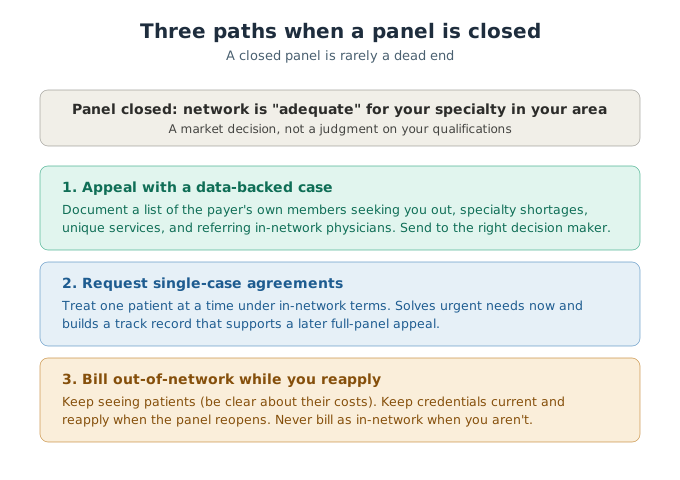
When a payer cites a closed panel, you have more options than just walking away. They fall into three categories: appeal for an exception, secure single-case agreements, or bill out-of-network while you wait.
Appeal With a Data-Backed Case
Providers don’t have to accept the first “no.” Many insurers will consider an appeal letter that makes a fact-based case for why an exception is warranted. The goal of the appeal is to prove that adding you benefits the payer’s members, not just you.
The arguments that actually move payers are specific and measurable:
- You offer something the existing network doesn’t. Specialized training, certifications, equipment, or procedures not otherwise available in the area. A niche capability is one of the strongest differentiators.
- The area is underserved. If patient-to-specialist ratios in your coverage area show a shortage, document it. Payers care about access gaps because regulators hold them to adequacy standards.
- The payer’s own members are seeking you out. This is the most underused tool. Keep a running list of patients (name and member ID) who came to you but couldn’t use their insurance because you were out-of-network. A list of 50 to 100 of the payer’s own members asking for you is a persuasive, concrete demonstration of demand.
- In-network providers already refer to you. If physicians on the payer’s panel send patients your way, that existing relationship is an argument for adding you.
- You fill an access gap. Extended hours, weekend availability, languages spoken, or telehealth capability that improves access for the payer’s members.
The mechanics matter as much as the content. Direct the appeal to the correct decision maker, usually the provider relations or credentialing representative assigned to your county, not a generic inbox. Send it both by email and by mail with delivery confirmation, and follow up with a phone call. An appeal that lands on the wrong desk gets no response regardless of how strong it is.
Is credentialing holding up your revenue?
Every day a provider sits uncredentialed is a day you can’t bill for their work. We take the whole process off your plate.
We handle all of it. Flat $150 per application, all 50 states, with clear status on every provider.
Get My Providers Credentialed → or call (307) 243 2190Request a Single-Case Agreement
A single-case agreement is a contract between you and the payer that lets you treat one specific patient under in-network terms even though the panel is closed. It’s a narrow, patient-specific workaround that solves the immediate problem and can open a longer-term door.
Single-case agreements work best when a patient has an urgent or specialized need that the in-network options can’t meet. From the payer’s side, agreeing is often easier than finding an in-network alternative. From your side, a string of single-case agreements demonstrates your value to the payer firsthand, and it’s cheaper for the payer to convert a proven provider to a full contract than to credential a brand-new applicant. Several single-case agreements can become the evidence base for a later panel appeal.
Bill Out-of-Network While You Wait
If the panel stays closed and appeals don’t land, you can still see the payer’s patients as an out-of-network provider. How much the patient’s plan reimburses for out-of-network care varies widely, and it usually means higher patient responsibility, so this requires clear communication with patients about their costs upfront.
Out-of-network billing is a legitimate bridge, but one rule is non-negotiable: never bill as in-network when you aren’t. Submitting claims that misrepresent your network status can constitute a false claim and carry serious penalties. Your billing team must verify panel status before every submission. The same care that prevents retroactive recoupment from a credentialing gap applies here.
The Long Game: Reapply on Schedule
Sometimes a panel is fully closed and the honest answer is that you have to wait. Insurers typically re-evaluate their panels periodically, often every three to twelve months, and a panel that’s closed today may reopen next quarter.
The providers who get in when panels reopen are the ones who are ready. Keep your credentials current, your CAQH profile attested, and your documents up to date so you can submit the moment a panel reopens. The full discipline of keeping a profile ready is covered in our guide to maintaining your CAQH ProView profile. Track each closed payer’s reapplication window and set a reminder to check status on schedule rather than hoping you happen to catch the reopening.
There’s also a regulatory tailwind worth knowing about. Starting in 2026, network adequacy oversight is tightening. State marketplaces must conduct network adequacy reviews before certifying plans, and regulators are scrutinizing whether the providers a plan claims are actually available and accepting new patients. When a payer’s network looks adequate on paper but isn’t in practice, that gap is leverage. A documented access problem in your area, raised with the right people, lands harder in 2026 than it would have a few years ago.
When to Get Help
Closed-panel appeals are winnable, but they’re won on specifics: the right decision maker, the right data, and a compelling, documented case. Providers handling this alone often send a generic letter to a generic address and get a generic rejection. The work of compiling patient demand lists, pulling specialty-shortage data, identifying referring in-network physicians, and routing the package to the actual credentialing representative is where appeals succeed or fail.
This is the kind of detailed, payer-specific work that an experienced credentialing partner handles routinely. It’s also closely tied to the rest of the credentialing process, since a closed panel often surfaces only after the full credentialing cycle the credentialing timeline guide walks through.
Frequently Asked Questions
A closed panel means the insurer has decided it already has enough providers of your specialty in your geographic area and is not accepting new in-network providers there. It is a network adequacy decision based on market need, not a judgment on your qualifications. The same payer may have open panels for your specialty in other areas.
Often, yes. You can appeal with a data-backed case showing you offer something the network lacks or that the area is underserved, request single-case agreements that demonstrate your value patient by patient, or wait and reapply when the panel reopens, which payers typically re-evaluate every three to twelve months. A strong, specific appeal directed to the right decision maker is the most direct path.
A single-case agreement is a contract between a provider and a payer that lets the provider treat one specific patient under in-network terms even when the panel is closed. It solves an immediate access need for one patient and can build a track record that supports a later request for full panel access.
Yes, as an out-of-network provider, but reimbursement and patient cost-sharing vary by plan, so patients should be told their expected costs upfront. You must never bill as in-network when you are out-of-network, because misrepresenting network status can constitute a false claim with serious penalties. Always verify panel status before submitting claims.
Insurers typically re-evaluate their panels every three to twelve months, so a panel that is closed now may reopen later. The providers who get in are the ones who keep their credentials and CAQH profile current and submit promptly when a panel reopens. Tracking each payer’s reapplication window is the key to catching the opening.
Don’t Let a Closed Panel Cost You Patients
A closed payer panel is frustrating, but it’s rarely the end of the road. Between data-backed appeals, single-case agreements, out-of-network billing, and disciplined reapplication, there’s almost always a path forward, and the tightening network adequacy rules in 2026 give well-documented providers more leverage than they’ve had in years.
MedBillingTech handles closed-panel appeals as part of our credentialing service, compiling the demand data, identifying the right decision makers, and building the fact-based case that gets exceptions granted. Flat fee of $150 per application, with appeal support included. Sixteen-plus years of payer enrollment experience across all 50 states.
Get Started With Credentialing →
If you’re facing a closed panel and want to know your real options, the free CredReady audit reviews your panel status across major payers and flags where appeals or reapplication are most likely to succeed, in 15 minutes.
Or call (307) 243 2190 to talk through a specific closed-panel situation.