A provider moves their practice from Texas to Oklahoma, one state over, with the same insurers they’ve worked with for fifteen years. They update the address in their EHR, hit save, and assume billing continues. Two weeks later, claims start bouncing. The provider, fully licensed and credentialed for over a decade, is now treated as a brand-new applicant by every payer in the new state, and none of their claims will pay until they re-credential.
Here is what catches most providers off guard: credentials do not automatically follow you when you relocate. Moving to a different state triggers a near-complete restart of the credentialing process with virtually every payer, including the national insurance companies. The Medicare enrollment you had in Florida does not transfer to North Carolina. The BCBS contract you held in Ohio starts fresh in Michigan.
This post explains why relocation forces re-credentialing, how the rules differ across four common relocation scenarios, and the steps that prevent a billing gap during the move.
Why Credentialing Doesn’t Travel With You
Insurance networks operate regionally, not nationally, even when the brand on the card is national. A credentialing approval in one state does not transfer to another because the entity holding your contract is usually a separate regional organization.
A Blue Cross Blue Shield contract in one state is held by a separate regional association from the one next door. The same is true across the board: national carriers including Cigna, Aetna, and UnitedHealthcare manage their provider networks at the state or regional level. A provider moving from Texas to Oklahoma is treated as a new applicant by the same insurers they have billed for years, because the Oklahoma network is administered separately from the Texas one.
Medicare works the same way. Medicare uses Medicare Administrative Contractors (MACs) that operate by state or region, and each MAC handles enrollment and claims processing within its own jurisdiction. When you move to a new state, you submit a complete enrollment package to the MAC administering that state’s program and obtain new Provider Transaction Access Numbers (PTANs) for both your business entity and yourself individually. Your enrollment record in the old state does not migrate.
State Medicaid programs are entirely separate entities, and enrolling in one state does nothing for another. Each state’s Medicaid program requires its own enrollment from scratch.
The Four Relocation Scenarios
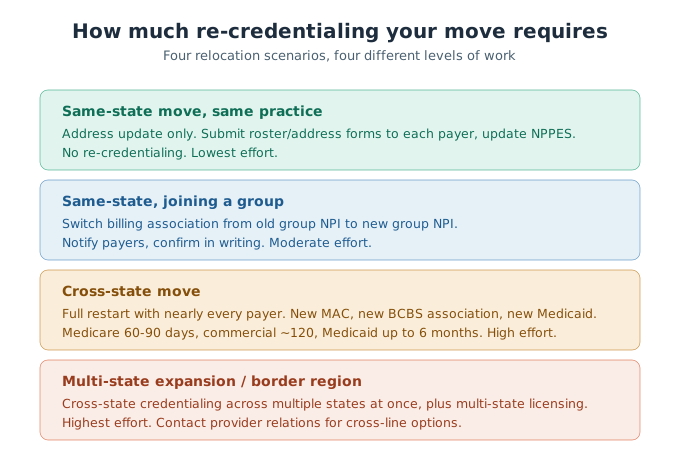
How much re-credentialing you face depends on which kind of move you’re making. There are four common scenarios, and they differ significantly.
Same-State Move, Same Practice
Moving offices within the same state, while keeping the same practice entity and Tax ID, is the simplest scenario. You are not re-credentialing, you are updating your address with each payer.
This still requires work. You submit an address change or roster update form to every insurance network you’re paneled with, some through provider portals, others via a formal relocation form. The address must also be updated in NPPES, because payers cross-reference claims against the National Provider Identifier registry to verify valid billing combinations. A mismatch between your new EHR address and your old credentialing file causes the clearinghouse to reject claims before they ever reach the payer.
The sequence matters: update credentialing with payers first, confirm the new address is active in their directories, then update the billing address in your practice management software. Changing the software address first guarantees rejections.
Same-State Move, Joining an Established Group
The one scenario where credentialing does not restart entirely is a same-state move where the provider is joining an established group practice that already holds active payer contracts. Here, the work is switching the provider’s billing association from the old group’s NPI to the new group’s NPI rather than filing fresh credentialing applications.
Even then, payers must be notified and records updated before claims can be submitted under the new group, and written confirmation is essential before assuming the transition is complete. The mechanics of adding a provider to a group’s contracts are covered in our guide to credentialing within a group practice.
Cross-State Move
Moving to a different state is the full restart. You re-credential with essentially every payer, even ones you’ve participated with for years, because the network in your new state is administered separately.
The timelines stack up. Medicare typically takes 60 to 90 days for a clean application to the new MAC, commercial credentialing runs around 120 days, and Medicaid can take six months or longer in slow states. These run in parallel, but the slowest payer determines when you’re fully operational in the new location. The full phase-by-phase breakdown is in our guide to how long credentialing takes.
Multi-State Expansion and Border Regions
Providers expanding into additional states, or practicing in a border region where patients come from neighboring states, face a version of cross-state credentialing across multiple jurisdictions at once. Each state requires its own licensing and payer enrollment.
For border-region practices, it’s worth contacting each payer’s provider relations representative directly. Some insurers acknowledge that providers practice across state lines and may offer ways to streamline the process. The licensing side of multi-state practice, including the compacts that speed it up, is covered in our guide to credentialing for multi-state telehealth.
Is credentialing holding up your revenue?
Every day a provider sits uncredentialed is a day you can’t bill for their work. We take the whole process off your plate.
We handle all of it. Flat $150 per application, all 50 states, with clear status on every provider.
Get My Providers Credentialed → or call (307) 243 2190The Steps That Prevent a Billing Gap
The difference between a smooth relocation and months of bounced claims comes down to sequencing and timing.
Start before you move. Cross-state credentialing takes 90 to 120 days or more, so begin the process months ahead of the physical move. A provider who waits until they’ve relocated to start credentialing is looking at a quarter or more with no billable revenue in the new location.
Update NPPES within 30 days. Any address or practice-location change must be reflected in NPPES within 30 days, per CMS requirements for keeping NPI data current. Payers cross-reference the registry, and outdated NPPES data triggers automated claim rejections. Mismatches between NPPES and your other systems are a leading cause of the data errors behind credentialing application rejections.
Update CAQH in lockstep. Your CAQH profile drives commercial credentialing, so the new address and any new state license have to be reflected and re-attested there. How the profile feeds payer verification is detailed in our guide to maintaining your CAQH ProView profile.
Sequence the address change correctly. Credentialing first, payer directory confirmation second, billing-software address change last. Reversing this order causes claim rejections from data mismatches.
Get the new state license early. Payer credentialing can’t start until the provider holds an active license in the new state. For physicians, the Interstate Medical Licensure Compact can expedite this. Build licensing time into the front of the timeline, not the middle.
Confirm in writing before billing. Do not assume any payer transition is complete until you have written confirmation that your new address and effective date are active in their directory. Billing on an assumption is how relocation gaps turn into denied or recouped claims.
Frequently Asked Questions
No. Insurance networks operate regionally, so credentialing does not transfer across state lines. Even national carriers like BCBS, Aetna, Cigna, and UnitedHealthcare administer their networks state by state, which means a cross-state move requires re-credentialing with essentially every payer, including ones you’ve participated with for years.
Yes. Medicare enrollment is tied to the Medicare Administrative Contractor (MAC) that administers your state. When you move to a new state, you must submit a complete enrollment package to the new state’s MAC and obtain new PTANs. Your old enrollment record does not transfer. Plan on 60 to 90 days for a clean application.
Your claims will likely be rejected. If you change the address in your practice management software before updating your credentialing file with each payer and NPPES, the clearinghouse detects a mismatch between your new address and your credentialing record and rejects the claims before they reach the payer. Always update credentialing first.
For a cross-state move, expect Medicare to take 60 to 90 days, commercial payers around 120 days, and Medicaid six months or longer in slow states. These run in parallel, but the slowest payer that matters to your revenue determines when you’re fully operational. Starting before the physical move is essential.
Yes. A same-state move with the same practice entity is an address-update process rather than full re-credentialing. You submit address change or roster update forms to each payer and update NPPES. If you’re joining an established group that already holds contracts, it’s a billing-association switch rather than new applications.
Relocating? Don’t Let Credentialing Stall Your Cash Flow
A practice move is stressful enough without a quarter of bounced claims on top of it. Because credentialing restarts with nearly every payer in a cross-state move, and even a same-state move requires careful address updates in the right sequence, relocation is one of the easiest ways to accidentally create a billing gap.
MedBillingTech handles relocation credentialing for solo providers, group practices, and multi-state expansions across all 50 states. Flat fee of $150 per application, with Medicare and Medicaid re-enrollment, commercial re-credentialing, NPPES and CAQH updates, and effective-date tracking included. Sixteen-plus years of payer enrollment experience.
Get Started With Credentialing →
If you’re planning a move and want to know exactly what you’ll need to re-credential, the free CredReady audit maps your current enrollments and flags what restarts in the new location, in 15 minutes.
Or call (307) 243 2190 to talk through your relocation timeline.