
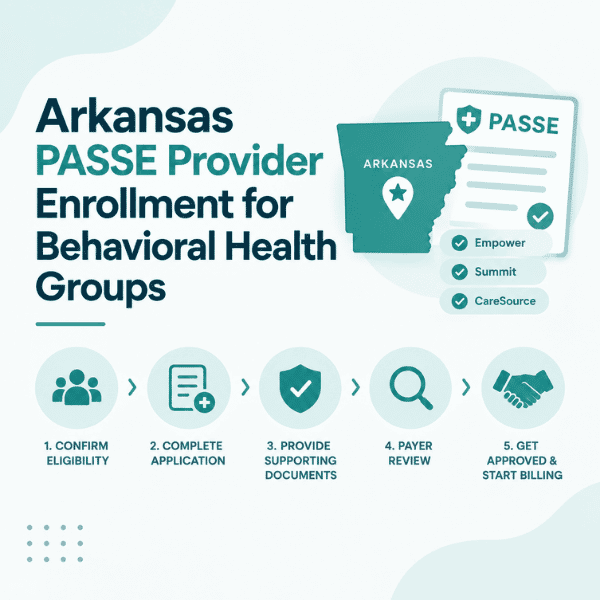
Arkansas runs a Medicaid model that catches out-of-state and even in-state behavioral health groups off guard: most Medicaid patients with complex behavioral health needs aren’t covered through standard Arkansas Medicaid at all. They’re covered through the PASSE program, a managed care structure that requires its own separate enrollment. A behavioral health group that gets a Medicaid provider ID and starts billing will find that claims for its highest-need patients deny, because a Medicaid ID does not include PASSE participation.
This is the single most expensive misunderstanding in Arkansas behavioral health billing. PASSE stands for Provider-led Arkansas Shared Savings Entity, and it’s Arkansas Medicaid’s managed care model for individuals with complex behavioral health needs and intellectual or developmental disabilities. If your practice treats that population, PASSE isn’t optional, and it isn’t automatic. It’s a second enrollment layer on top of standard Medicaid, with four separate organizations to contract with.
This post explains how PASSE works, how enrollment actually happens, and what trips behavioral health groups up.
What PASSE Actually Is
PASSE is Arkansas’s managed care program for Medicaid beneficiaries with the most complex behavioral health and developmental disability needs. Rather than paying for these services through traditional fee-for-service Medicaid, the state contracts with private organizations (the PASSEs) that coordinate and manage the full range of a member’s care: physical health, behavioral health, and home and community-based services.
The PASSEs integrate physical, behavioral, and specialized services under a single managed care entity, and each is majority owned by Arkansas Medicaid providers as established by state law. There are four PASSE organizations operating in Arkansas:
- Arkansas Total Care
- CareSource PASSE
- Empower Healthcare Solutions
- Summit Community Care
A key detail for providers: members aren’t assigned to a PASSE by geography. New members are distributed among the four PASSEs through a rotating assignment, and members can change their PASSE within 90 days of enrollment or during annual open enrollment. Because assignment is by rotation rather than region, your patients will be spread across all four PASSEs. A group that contracts with only one can bill for only the fraction of its patients assigned to that PASSE.
Who PASSE Covers
Not every Medicaid behavioral health patient is in PASSE. The program is specifically for higher-acuity members, which shapes who a behavioral health group will and won’t bill through it.
Beneficiaries are enrolled in a PASSE if they have a behavioral health diagnosis and need services beyond counseling and medication management, and have an active Independent Assessment that identifies them as Tier 2 or higher. The tiering comes from the Arkansas Independent Assessment (ARIA), which determines a member’s level of need. Tier 1 members (counseling-level services) stay in standard Medicaid. Tier 2, 3, and 4 members (institutional-level need and above) move into PASSE.
For a behavioral health group, this means your patient panel likely splits across two systems. Your lower-acuity patients bill through standard Arkansas Medicaid. Your higher-acuity patients, the ones needing intensive services, bill through whichever of the four PASSEs they’re assigned to. You need enrollment in both to bill your full panel.
The Two-Layer Enrollment Trap
Here is the mistake that costs Arkansas behavioral health groups the most money. Getting an Arkansas Medicaid provider ID does not enroll you with the PASSEs. When an Arkansas group calls us about a wall of unexplained denials, this is almost always what we find: a valid Medicaid ID, months of services to Tier 2+ patients, and no PASSE contracts behind them. They are separate contracts, and skipping the second layer means denied claims for your highest-need patients.
The structure works in two layers:
Layer one: enroll with Arkansas Medicaid. You register through the state’s Medicaid Management Information System (MMIS) provider portal and receive your Division of Medical Services (DMS) provider ID. This is the foundation, and it’s required, but on its own it only lets you bill standard fee-for-service Medicaid.
Layer two: contract separately with each PASSE. A DMS provider ID does not automatically include PASSE participation. Providers who treat PASSE members without a separate contract will not be reimbursed, and retroactive payment is rarely approved. Each PASSE has its own network, its own provider agreement, its own credentialing process, and its own provider manual. To reach your full patient panel, you enroll with all four.
Providers who want to serve all eligible beneficiaries in their area must enroll with each PASSE organization and comply with each PASSE’s specific provider manual. This is four separate contracting processes, four sets of paperwork, and four credentialing reviews, on top of the state enrollment.
Arkansas is not the only state where a Medicaid ID falls short. Tennessee runs a comparable two-layer model, and our guide to behavioral health credentialing in Tennessee shows how the same trap appears there, with three TennCare MCOs to contract with after state registration.
How PASSE Enrollment Actually Works
The full path to billing PASSE members follows a clear sequence, even though it involves multiple parties.
First, complete your core Arkansas Medicaid enrollment through the MMIS portal and obtain your DMS provider ID. Individual practitioners are exempt from the federal application fee; the $750 CY2026 fee applies to institutional providers, and individual physicians, non-physician practitioners, and groups of individual practitioners are exempt, as are providers who already paid the fee through Medicare.
Second, ensure your CAQH profile is complete and attested, since the PASSEs draw on it during credentialing the same way commercial payers do. The same 120-day attestation discipline covered in our CAQH ProView profile guide applies here.
Third, contact each of the four PASSEs to begin contracting. Review and sign each PASSE’s provider agreement, which sets out your obligations with that organization. Each runs its own credentialing review and has its own timeline.
Fourth, once contracted, use each PASSE’s claims system to submit claims for that PASSE’s members. Each has its own submission process and requirements laid out in its provider manual.
Because Arkansas Medicaid is a portfolio of programs rather than one system, this is more involved than enrolling in a single state’s straightforward Medicaid program. The broader mechanics of how state Medicaid enrollment works are covered in our Medicaid provider enrollment guide; PASSE is the Arkansas-specific layer that sits on top of it.
Are you enrolled with all four PASSEs?
The audit maps your Arkansas enrollment across every layer and flags where you’re leaving Medicaid revenue on the table:
What Trips Behavioral Health Groups Up
A few recurring issues account for most of the lost revenue in Arkansas PASSE billing.
Assuming a Medicaid ID is enough. The most common and costly error. A group enrolls with Arkansas Medicaid, starts billing, and finds that claims for its complex behavioral health patients deny because those patients are in PASSE and the group never contracted with the PASSEs. Retroactive payment for those denied claims is rarely approved, so the revenue is usually gone.
Contracting with only one or two PASSEs. Because members are assigned by rotation, not geography, your patients are spread across all four. A group contracted with only Empower can’t bill patients assigned to Summit, CareSource, or Arkansas Total Care. Reaching your full panel means enrolling with all four.
Underestimating the credentialing load. Four PASSE contracts plus state enrollment means five separate credentialing processes, each with its own provider manual, timeline, and revalidation cycle. For a multi-provider group, that multiplies across every clinician. Tracking it without a system is where deadlines slip.
Missing the tier distinction. Some groups assume all their Medicaid behavioral health patients are in PASSE, or that none are. The reality splits by ARIA tier. Knowing which patients are Tier 2+ (and therefore in PASSE) versus Tier 1 (standard Medicaid) determines which system each claim goes through.
Not tracking revalidation across all five enrollments. State Medicaid and each PASSE have their own maintenance requirements. A lapse in any one drops that slice of your billing, the same lapse dynamic covered in our re-credentialing deadline guide.
Frequently Asked Questions
PASSE (Provider-led Arkansas Shared Savings Entity) is Arkansas Medicaid’s managed care model for beneficiaries with complex behavioral health needs and intellectual or developmental disabilities. Four organizations (Arkansas Total Care, CareSource PASSE, Empower Healthcare Solutions, and Summit Community Care) coordinate and manage the full range of care for these members, including physical health, behavioral health, and home and community-based services.
No. A Division of Medical Services (DMS) provider ID lets you bill standard fee-for-service Medicaid, but it does not include PASSE participation. To bill for PASSE members, you must contract separately with each PASSE organization. Providers who treat PASSE members without a separate contract are not reimbursed, and retroactive payment is rarely approved.
To reach your full patient panel, all four. PASSE members are assigned to organizations by a rotating distribution rather than by geography, so your patients will be spread across Arkansas Total Care, CareSource PASSE, Empower Healthcare Solutions, and Summit Community Care. A group contracted with only one PASSE can bill only the fraction of its patients assigned to that PASSE.
PASSE covers Medicaid beneficiaries with a behavioral health diagnosis who need services beyond counseling and medication management and who are assessed at Tier 2 or higher through the Arkansas Independent Assessment (ARIA). Lower-acuity Tier 1 patients remain in standard Arkansas Medicaid. Most behavioral health groups have patients in both systems and need enrollment in both.
For CY2026, the federal application fee is $750, but it applies only to institutional providers. Individual physicians, non-physician practitioners, and groups of individual practitioners are exempt, as are providers who already paid the fee through Medicare enrollment. The fee is paid within the MMIS portal during enrollment.
Get Enrolled Across Every PASSE Without the Guesswork
Arkansas PASSE enrollment is where behavioral health groups leave the most Medicaid revenue on the table, not because the work is hard, but because the two-layer structure is easy to miss until claims start denying. Getting enrolled with Arkansas Medicaid and contracted with all four PASSEs, cleanly and in the right order, is what lets you bill your full patient panel.
Credentialing problems are easier to prevent than to unwind, but only if you can see them before a payer does. The free credentialing audit reviews your enrollment status across every major payer, flags the gaps most likely to stall claims, and gives you a clear picture in about 15 minutes. Take a look at where you stand, or call (307) 243-2190 to talk through your situation.



Pingback: Behavioral Health Credentialing in Tennessee: TennCare Guide
Pingback: Medicaid Provider Enrollment: A Practical 2026 Guide
Pingback: Provider Credentialing: The Complete Guide (2026)