
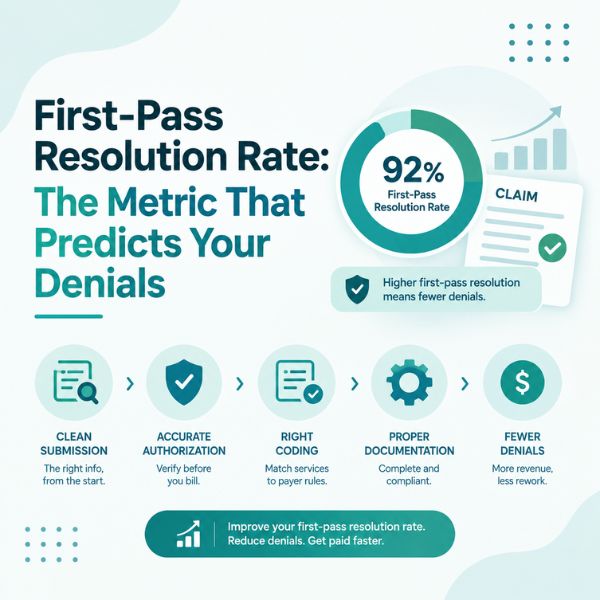
First-pass resolution rate is the percentage of claims that are paid in full on the first submission, with no rework, resubmission, or appeal. It is the strictest and most honest measure of billing performance, because it counts only the claims that went all the way to full payment cleanly the first time. Everything else, every claim that was accepted but underpaid, denied, reworked, or appealed, counts against it.
That strictness is exactly what makes first-pass resolution rate valuable. Most billing metrics measure one stage of the process. Clean claim rate measures whether a claim was accepted for processing. Denial rate measures how many claims were rejected. First-pass resolution rate measures the only outcome that actually matters: did you get paid, in full, without having to touch the claim again. A practice can look healthy on every other metric and still have a first-pass resolution rate that reveals significant revenue leaking into rework.
This post explains how to calculate first-pass resolution rate, what a healthy number looks like, why it’s stricter than clean claim rate, and what drags it down.
How to Calculate First-Pass Resolution Rate
The formula is: claims paid in full on first submission divided by total claims submitted, multiplied by 100.
A worked example. If your practice submits 1,000 claims in a month and 880 of them are adjudicated and paid in full on the first pass with no rework, your first-pass resolution rate is 880 divided by 1,000, times 100, which is 88%.
The critical word in the definition is “paid.” A claim only counts toward first-pass resolution if it was paid in full on first adjudication. A claim that was accepted, then underpaid, then had to be worked to recover the balance does not count, even though it passed every formatting edit and never technically “denied.” This is what separates first-pass resolution rate from softer metrics: it counts the outcome, not the submission.
Track it monthly and break it down by payer and by provider. A low first-pass resolution rate almost always points to a specific payer or provider combination rather than a general process failure, which makes the fix targeted and fast. The blended number tells you there’s a problem; the segmented view tells you exactly where it lives.
What’s a Healthy First-Pass Resolution Rate?
The widely used industry benchmark is 90% or higher, with top performers reaching 95%. HFMA’s MAP Keys, the standard revenue-cycle KPIs, set the closely related clean claim rate benchmark around 95%, and first-pass resolution, which is stricter, is commonly held to a 90%-and-above target. Below 80%, the administrative rework burden becomes financially significant, and the number warrants immediate process review.
Here’s the reality check that makes this metric worth adding to your report: most practices sit below the 90% benchmark without realizing it, because they measure clean claim rate and net collection rate and never calculate the one metric that would expose the gap. The practices that look fine on every other number are often the ones leaving the most revenue in rework.
As with the other revenue cycle metrics, the benchmark varies by specialty and payer mix. Surgical specialties with heavy bundling rules and behavioral health with heavy medical-necessity requirements run lower and have to work harder to reach 90%. Your own month-over-month trend, segmented by payer, tells you more than any single comparison against a national figure.
Why It’s Stricter Than Clean Claim Rate
This is the distinction that makes first-pass resolution rate worth tracking, and it’s the one most practices miss. Clean claim rate and first-pass resolution rate sound similar, but they measure two different things, and the gap between them is where revenue quietly disappears.
Clean claim rate stops at submission. It measures whether a claim passed formatting edits and was accepted by the clearinghouse and payer for processing. First-pass resolution rate goes all the way to payment. It measures whether the claim was actually adjudicated and paid in full without rework.
The consequence is that a claim can be perfectly clean and still fail first-pass resolution. It can pass every scrubber edit, get accepted, and then be denied for prior authorization, medical necessity, or eligibility, none of which a formatting scrubber catches. Or it can be paid, but underpaid against your contracted rate, which counts as clean and counts as a payment but is not full first-pass resolution.
That gap is the point. A practice can run a very high clean claim rate and a much lower first-pass resolution rate at the same time, and the difference is claims that passed submission but did not get paid in full on the first try. If clean claim rate is the only front-end metric you track, that gap is invisible. This is the specific relationship covered in our guide to measuring your clean claim rate: clean claim rate is the upstream control, and first-pass resolution rate is the outcome it’s supposed to produce. When the two diverge, the gap is your rework.
Put it in dollars. Say a practice submits 1,000 claims a month at an average allowed amount of $180, and runs a 96% clean claim rate. On paper that looks healthy, 960 claims sailed through submission. But if its first-pass resolution rate is 82%, then 180 of those claims were accepted and still didn’t get paid in full on the first try. That’s roughly $32,000 in claims every month cycling back through rework, waiting on appeals, corrections, and underpayment recovery, and some share of it ages out to write-off before anyone collects it. The clean claim rate never showed a problem. The first-pass resolution rate is the only number that did.
A clean claim rate can hide a lot
We calculate your true first-pass resolution rate and show you the money sitting between “accepted” and “paid in full”:
What Drags First-Pass Resolution Rate Down
A first-pass resolution rate below benchmark comes from a specific set of causes, and notably, several of them are things a claim scrubber cannot catch, which is why they show up in first-pass resolution rate but not clean claim rate.
| What fails the claim | What triggers it | Why the scrubber misses it |
|---|---|---|
| Contractual underpayment | Payer pays below your contracted rate | The claim paid, so nothing flags as an error |
| Prior authorization | Auth missing, expired, or wrong for the service | Format is valid; the auth problem is a payer rule |
| Medical necessity | Diagnosis or documentation doesn’t support the code | A scrubber checks format, not clinical support |
| Bundling / modifier | NCCI edit or a missing or wrong modifier (often 25) | Passes basic edits; denies on payer adjudication |
| Eligibility change | Coverage lapsed after you verified it | Was valid when scrubbed; changed by date of service |
The pattern connecting most of these: they’re back-end and mid-cycle failures on claims that were clean at the front end. That’s precisely why first-pass resolution rate predicts your denials better than clean claim rate does. It catches the problems that survive the scrubber. Two of these deserve a closer look, because they’re the ones practices most often miss entirely.
How to Actually Catch Underpayments
Underpayments are the single most overlooked driver, and they’re invisible unless you check for them deliberately, because the claim shows as paid. The mechanics are straightforward but almost no small practice does them: pull the 835 electronic remittance for each claim, find the payer’s “allowed amount” on each line, and compare it against your contracted fee schedule for that CPT code and that payer. Any line where the allowed amount is less than your contracted rate is an underpayment.
When we load a new practice’s fee schedules, an underpaying payer is almost always one of the first things that surfaces, and it’s usually one nobody was watching. The reason it hides is that catching it requires maintaining a loaded fee schedule for every payer, and most practices never build one. Without it, there’s nothing to compare the payment against, so the underpayment passes silently. The common patterns worth watching: a payer applying the wrong fee schedule year, applying an incorrect multiple-procedure reduction, or downcoding a line and paying the lower rate without flagging it. Each shows up as a claim that paid, looked fine, and quietly came in under contract.
The Authorization and Eligibility Gap
The other cluster a scrubber can’t touch is timing. Authorization and eligibility are both verified before the visit, but they can change by the date of service. An authorization can expire, cover the wrong service, or be tied to a different provider than the one who saw the patient. Coverage verified two weeks ago can lapse before the appointment. In both cases the claim is formatted correctly and passes submission cleanly, then denies on a payer rule the scrubber was never checking. The fix is to verify as close to the date of service as possible and to confirm authorization matches the exact service, provider, and dates, not just that an authorization number exists. This is the same CO-197 denial pattern that traces back to front-end gaps.
How to Raise Your First-Pass Resolution Rate
First-pass resolution rate improves when you close the gaps a scrubber can’t. The highest-leverage moves target the specific causes above.
Compare every payment against your contracted fee schedule so underpayments get caught and recovered instead of silently suppressing the number. Verify eligibility and benefits as close to the date of service as possible, and confirm authorization requirements before every applicable service, so auth and eligibility denials never happen. Audit documentation against billed codes for the services most prone to medical-necessity denials, and run modifier and bundling logic beyond basic formatting scrubbing. And segment the number by payer and provider every month, because the fix is almost always concentrated in one or two payer relationships, not spread across the whole operation.
A practice starting below benchmark can usually reach 90% within a quarter or two by adding underpayment monitoring and tightening front-end authorization and eligibility, and the gain compounds, because every claim resolved on the first pass is a claim that never enters the rework cycle that inflates days in AR and erodes net collection rate.
Frequently Asked Questions
A good first-pass resolution rate is 90% or higher, with top performers reaching 95%, the widely used industry benchmark. (HFMA’s MAP Keys, the standard revenue-cycle KPIs, benchmark the closely related clean claim rate around 95%.) Below 80% signals systematic front-end problems and warrants immediate process review. Most practices sit below the benchmark without realizing it, because they track clean claim rate and net collection rate instead of the metric that measures full payment on first submission.
Divide the number of claims paid in full on first submission by the total number of claims submitted, then multiply by 100. For example, 880 claims paid clean out of 1,000 submitted is an 88% first-pass resolution rate. The key is that a claim only counts if it was paid in full on first adjudication, so claims that were underpaid, denied, or reworked do not count.
Clean claim rate measures whether a claim passed formatting edits and was accepted for processing. First-pass resolution rate measures whether the claim was actually paid in full on first submission without rework. A claim can be clean but still fail first-pass resolution if it’s denied for authorization, medical necessity, or eligibility, or if it’s underpaid. First-pass resolution rate is the stricter metric, and the gap between the two is your rework.
First-pass resolution rate is important because it measures the only outcome that matters: getting paid in full without rework. It catches problems that clean claim rate misses, especially contractual underpayments and back-end denials, so it predicts your true denial and rework burden better than any single-stage metric. Tracking it exposes revenue leakage that other metrics hide.
The main causes are contractual underpayments, prior authorization mismatches, medical necessity and documentation gaps, bundling and modifier errors, and eligibility changes after verification. Notably, several of these are things a claim scrubber cannot catch, which is why they show up in first-pass resolution rate but not clean claim rate.
The Number That Tells You the Truth About Your Billing
First-pass resolution rate is worth calculating precisely because it’s unforgiving. It counts only the claims that got paid in full without a second touch, and the gap between it and your clean claim rate is revenue sitting in rework, often from underpayments and back-end denials that never surface on the metrics most practices watch. If you track one new number this quarter, make it this one.
MedBillingTech runs full-cycle medical billing for independent practices, with underpayment monitoring against contracted rates, front-end authorization and eligibility verification, and denial management that keeps claims out of the rework cycle. Billing is priced at 3.99% of collections, with no long-term lock-in and a 97% client retention rate. Mark Wood, our COO, has spent more than 20 years in revenue cycle operations.
If you want to know what your first-pass resolution rate really is and where the rework is hiding, our free revenue audit calculates it from your claims data and shows you which payers are driving the gap. Or call (307) 243-2190 to talk it through with someone who works these numbers every day.


Pingback: Clean Claim Rate: Benchmarks and How to Improve It
Pingback: Days in AR: Benchmarks and How to Fix a Rising Number
Pingback: Net Collection Rate: Benchmarks and How to Improve It
Pingback: In-House vs Outsourced Medical Billing: Real Cost Compared
Pingback: Common Medical Billing Denial Codes and How to Fix Each
Pingback: What Happens When You Outsource Medical Billing