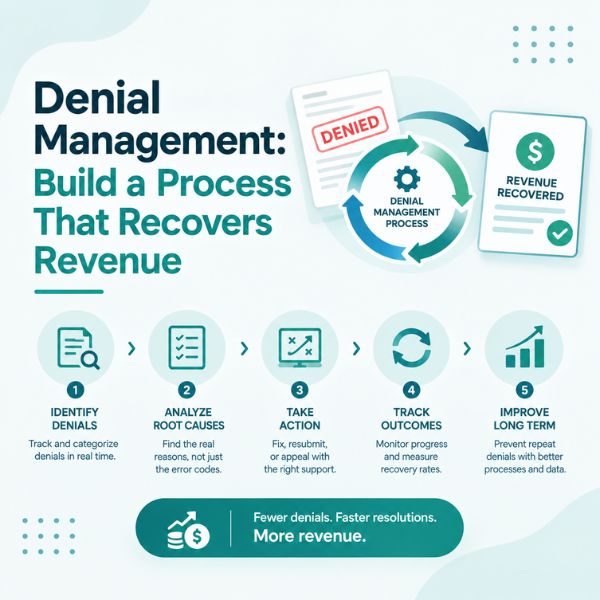
Denial management is the end-to-end process of catching denied and underpaid claims, finding out why, fixing the recoverable ones, and stopping the cause so they don’t come back. Most practices don’t have that process. What they have is a pile of denials someone works when there’s time, which means denials get reworked inconsistently, appeals rarely get filed, and a large share of earned revenue quietly becomes a permanent write-off. The gap between those two approaches, a system versus a scramble, is one of the largest recoverable revenue opportunities in a practice.
The numbers behind this are stark. MGMA’s 2024 benchmarking found more than half of healthcare organizations report denial rates above 10%, well past the low-single-digit rate HFMA considers the acceptable standard. And the money doesn’t just sit there waiting; a majority of denied claims are never reworked at all, which turns a recoverable denial into lost revenue by default. Denial management is how you stop defaulting.
This post lays out the denial rate benchmarks that tell you if you have a problem, the four-stage process that recovers revenue, and how to build a workflow that prevents denials instead of just chasing them.
What’s a Healthy Denial Rate?
A healthy first-pass denial rate sits in the low single digits, and most practices are nowhere near it. HFMA treats a denial rate in the mid-single digits as the acceptable ceiling, with top performers under 5%, while widely cited industry data puts the average initial denial rate around 11.8% in 2024, up from roughly 10.2% a few years earlier. MGMA’s 2024 benchmarking found more than half of organizations now run above 10%, so if your rate is double digits, you’re in the majority, but the majority is losing money.
The benchmark varies by specialty, and the variation is large enough that a raw number means little without context. Behavioral health runs among the highest denial rates of any specialty, driven by authorization and medical-necessity requirements. Primary care and internal medicine run lower. A denial rate that’s alarming for a primary care practice might be normal for behavioral health, which is why you benchmark against your specialty and your own trend, not a single national figure.
Two things have pushed denial rates up recently and are worth knowing about. Payers now run claims through automated adjudication that flags modifier, diagnosis, authorization, and eligibility issues in seconds, so errors that used to slip through manual review now deny automatically. And the 2026 NCCI bundling edits were one of the largest single-cycle updates in years, meaning code pairs that were billable separately a year ago now bundle, generating fresh denials for practices that didn’t update their charge capture. The environment is getting stricter, not looser.
Why Denials Become Permanent Losses
The most expensive fact in denial management is that most denials are never worked. A majority of denied claims are simply never reworked or appealed, which means the revenue isn’t denied so much as abandoned. This is not a payer problem; it’s a workflow problem, and it’s the single biggest reason denial management pays for itself.
The reason denials get abandoned is that working them is labor-intensive and unglamorous. Each denial has to be investigated, corrected, resubmitted, or appealed, and industry estimates put the cost to rework a single claim in the range of $25 to over $100 in staff time. When a small team is buried, denials lose to more urgent work, age past timely-filing deadlines, and convert to write-offs. The claims that were most recoverable on day one become uncollectible by day ninety.
What makes this doubly costly is that appealable denials win at high rates when someone actually files. Well-documented first-level appeals overturn a large share of denials, yet most are never filed. So the money is not just recoverable in theory; it’s recoverable at a good success rate, and it’s being left on the table for lack of a process. That’s the opportunity a real denial-management system captures, and it’s why chasing denials one at a time in spare moments is the wrong model. When we take over a practice’s AR, the unworked denial pile is almost always where the fastest recovery is, claims that were winnable all along and just never got touched.
How much is sitting in your denial pile?
We quantify the recoverable revenue in your denials and show you why they’re happening:
The Four Stages of Denial Management
Effective denial management runs as a defined four-stage cycle, not an ad hoc scramble. Each stage has a job, and skipping any one is where revenue leaks.
Stage 1: Identify. Catch every denial and underpayment as it posts, reading the full remittance: the group code, the Claim Adjustment Reason Code (CARC), and the remark code together. This is also where underpayments get caught, the claims that paid but paid short, which never show up as denials at all and are invisible without deliberate checking.
Stage 2: Categorize by root cause. Sort denials by why they happened, not just by code: eligibility, authorization, coding, documentation, timely filing, or credentialing. Categorization is what turns a denial list into a diagnostic. A pile of 40 denials is noise; “18 authorization, 12 eligibility, 10 coding” is a map that tells you which upstream process to fix.
Stage 3: Resolve. Route each denial to its correct response, a corrected claim for a data error, an appeal with documentation for a clinical or coverage dispute, a patient bill for a legitimate patient-responsibility balance, or a write-off for the genuinely uncollectible. Speed matters here: appeals and corrections filed within about two weeks of denial consistently outperform later ones, because timely-filing windows are closing the whole time.
Stage 4: Prevent. Feed what you learned back upstream. If authorization denials spiked, fix the authorization process. If a payer keeps denying a code pair, fix the coding workflow. Prevention is what separates denial management from denial rework; it shrinks the denial pile at the source instead of working it forever. This is where denial management connects to your clean claim rate and first-pass resolution rate: every prevented denial is a claim that resolves on the first pass.
The Metrics That Tell You It’s Working
Denial management is measurable, and a few numbers tell you whether your process is actually recovering revenue or just processing paperwork.
Track your denial rate (the share of claims denied on first submission) against your specialty benchmark and your own trend. Track your appeal win rate (the share of appealed denials overturned), because a low number means your appeals are weak or you’re appealing the wrong denials. Track your denial-to-resolution time, because slow resolution is how recoverable claims age out. And track the percentage of denials never worked, which is the number most practices would rather not look at and the one that reveals the most.
These don’t stand alone. Denials push up days in AR as claims wait to be reworked, and unworked denials that age out drag down net collection rate as they convert to write-offs. Denial management sits upstream of both. Fix the denial process and those downstream metrics improve on their own, which is why the practices with the best net collection rates are usually the ones with the most disciplined denial workflow, not the most aggressive collectors.
How to Build the Process
Turning this into an operating system, rather than a good intention, comes down to a few structural commitments.
Assign clear ownership, so denials are someone’s defined job rather than everyone’s spare-time task. Set a resolution cadence, working denials on a fixed schedule (ideally within two weeks of posting) so nothing ages out. Build templated appeal packages by denial type and payer, with the documentation each one needs, so filing an appeal is a repeatable task rather than a research project every time. Categorize and track denials by root cause monthly, so the prevention loop has data to act on. And review the patterns regularly, because a spike in one denial category is a signal about an upstream process that’s breaking.
For many practices, the honest answer is that this is more than a busy front office can sustain, which is where the never-worked pile comes from. A dedicated denial function, in-house or outsourced depending on your volume, is what turns denial management from an aspiration into a system that actually recovers the revenue.
Frequently Asked Questions
Denial management is the end-to-end process of identifying denied and underpaid claims, determining why they were denied, resolving the recoverable ones through corrected claims or appeals, and preventing the same denials from recurring. It’s a defined workflow, not a one-time cleanup, and its goal is to convert denied claims back into paid revenue while shrinking the denial rate at the source.
A good first-pass denial rate is in the low-to-mid single digits, with top performers under 5%, per HFMA. The average initial denial rate was around 11.8% as of 2024 industry data, and MGMA’s 2024 benchmarking found more than half of organizations run above 10%. Benchmarks vary widely by specialty, behavioral health runs much higher than primary care, so compare against your specialty and your own trend rather than a single national number.
Because working denials is labor-intensive and often loses to more urgent work. Each denial must be investigated, corrected, and resubmitted or appealed, at a cost of roughly $25 to over $100 in staff time per claim. When a small team is overwhelmed, denials age past timely-filing deadlines and become write-offs. A majority of denied claims are never reworked at all, which is a workflow failure, not an inevitability.
Within about two weeks of the denial posting. Appeals and corrected claims filed promptly consistently outperform later ones, because timely-filing windows are closing the entire time a denial sits. A fixed resolution cadence, rather than working denials whenever there’s spare time, is what prevents recoverable claims from aging into uncollectible write-offs.
Yes. Denial management sits upstream of days in AR and net collection rate. Denials that wait to be reworked inflate days in AR, and denials that age out drag down net collection rate as they become write-offs. Fixing the denial process improves both downstream metrics automatically, which is why disciplined denial management is one of the highest-leverage investments in a revenue cycle.
Stop Letting Recoverable Denials Become Write-Offs
Most practices lose real money not because their denials are unwinnable, but because there’s no process to work them, so recoverable claims age out and become permanent write-offs. A defined denial-management system (identify, categorize, resolve, prevent) turns that abandoned revenue back into collections and shrinks the denial rate at the source.
MedBillingTech runs full-cycle medical billing for independent practices at 3.99% of collections, with a denial-management process that works every denial to its correct resolution, files appeals on a schedule, and feeds root causes back upstream so denials stop recurring. No long-term lock-in, and a 97% client retention rate. Mark Wood, our COO, has spent more than 20 years in revenue cycle operations.
If you want to know how much recoverable revenue is sitting in your denial pile, our free revenue audit reviews your denial rate, your never-worked claims, and where the recoverable money is. Or call (307) 243-2190 to talk through your denials.