
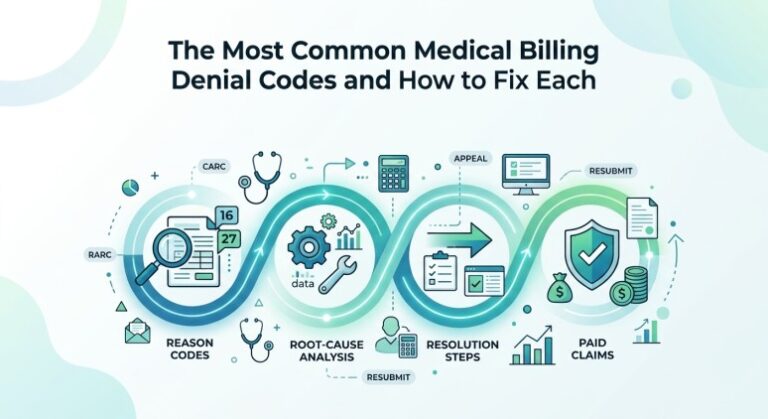
Every denied or reduced claim comes back with a code that tells you exactly why. Learning to read those codes, and knowing the right response to each, is the difference between a billing operation that recovers denied revenue and one that writes it off. Most practices react to denials one at a time without recognizing that a short list of codes accounts for the overwhelming majority of them, and each one has a specific, repeatable fix.
The codes are standardized. The X12 committee maintains the national set of Claim Adjustment Reason Codes, and every payer, Medicare, Medicaid, and commercial, uses the same set. That standardization is good news: once you know what CO-97 means and how to handle it, you know it for every payer. This post breaks down the denial codes practices see most, what each one actually means, and the exact action that resolves it. Denials are one piece of the wider billing picture, covered end to end in our guide to medical billing services.
How to Read a Denial Code Before You Do Anything
Before getting into specific codes, you have to understand that a denial isn’t one code, it’s three layers working together. Acting on just one of them is the single most common and costly denial-handling mistake.
Every adjustment on a remittance advice (the ERA, or 835 transaction) has three parts:
The group code tells you who owns the balance. The four you’ll see are CO (Contractual Obligation, a provider write-off you cannot bill the patient for), PR (Patient Responsibility, meaning the balance moves to the patient), OA (Other Adjustment, a catch-all), and PI (Payer Initiated Reduction). The group code decides what you’re even allowed to do next.
The CARC (Claim Adjustment Reason Code) is the numeric code that tells you why the payment changed. This is the “denial code” most people mean.
The RARC (Remittance Advice Remark Code) is the remark code that gives the specific detail. Some CARCs, especially CO-16, are almost useless without the RARC that accompanies them, because the CARC says “something’s missing” and the RARC tells you what.
The rule that saves the most money: read all three together before acting. The most common mistake we see when we take over a denial backlog is a team that worked the CARC and ignored the RARC, reworking and resubmitting claims that just bounce again for the same unaddressed reason. A CARC without its RARC often doesn’t tell you enough to fix the claim, and misreading a PR adjustment as a denial (or a CO write-off as appealable) sends your team down the wrong path entirely. Never act on the CARC alone.
One more critical distinction up front. The most frequent code on almost any remittance, CO-45, is not actually a denial. It’s a contractual adjustment, the difference between your billed charge and the contracted rate you already agreed to. It’s expected on nearly every claim. The true denials, where payment is actually withheld and revenue is at risk, are a different set. Confusing the two wastes enormous time.
The Contractual Adjustment Codes (Usually Not Denials)
These codes reflect the agreed difference between what you billed and what your contract allows. They’re mostly normal, but they’re worth understanding because they’re the highest-volume codes you’ll see.
CO-45: Charge exceeds the fee schedule or contracted amount. This is the write-off between your billed charge and the payer’s allowed amount. On nearly every claim, some CO-45 is expected and correct. Because it carries the CO group code, you cannot bill the patient for it. The trap is assuming CO-45 is always correct. If the CO-45 amount looks larger than it should, don’t write it off reflexively. Pull your contracted fee schedule for that payer and compare the allowed amount on the ERA to your contracted rate. Payers underpay against contracted rates more often than most practices realize, and an unexamined CO-45 is where that underpayment hides. The fix isn’t a resubmission, it’s contract reconciliation, and catching systematic underpayments here is one of the most overlooked levers on your net collection rate.
CO-97: The service is bundled into another payment. The payer considers this service part of another procedure already reimbursed, usually under NCCI bundling edits. Sometimes that’s correct. Sometimes the services were genuinely distinct and the bundling is wrong. If they were separate (different anatomical site, separate encounter, separate provider), append the correct modifier (often 59 or an X-modifier) with documentation supporting the distinction, and resubmit. If they weren’t distinct, it’s a legitimate write-off. The prevention is running an NCCI edit checker before submission and training coders on modifier use.
The True Denials Worth Mastering
These are the codes where payment is actually withheld, and where correct handling recovers real money. Each has a distinct cause and a distinct fix.
CO-16: Claim lacks information or has a submission error. This is one of the most common true denials, and it’s almost always paired with a RARC that tells you exactly what’s missing, a missing modifier, an invalid procedure code, a missing NDC, incomplete patient data. The CO-16 itself just says “something’s wrong.” The RARC (an N-series or M-series remark like M51, M119, or MA130) says what. Read the RARC, fix the specific element, and submit a corrected claim. CO-16 is almost entirely preventable with front-end claim scrubbing that catches missing fields before the claim leaves the building.
CO-50: Not deemed medically necessary. The payer determined the service wasn’t medically necessary as billed, usually because the diagnosis code doesn’t support the procedure under the payer’s coverage policy. The fix is to verify the ICD-10 code accurately reflects the documented condition and supports medical necessity under the payer’s LCD or coverage policy. If the documentation supports it, appeal with the clinical records attached. Prevention means checking diagnosis-to-procedure support and payer medical necessity policies before the visit.
CO-11: Diagnosis and procedure mismatch. The diagnosis code doesn’t match or support the procedure code billed. This is a coding error. Review the documentation, correct the diagnosis or procedure code so they align, and resubmit a corrected claim. Recurring CO-11 denials point to a coding workflow problem worth auditing.
CO-197: Precertification or authorization was required but not obtained. A service that needed prior authorization was performed without it. This is one of the most preventable, and most infuriating, denials, because the fix has to happen before the service. If the authorization requirement was missed, some payers allow a retroactive authorization request or an appeal with clinical justification, but success is far from guaranteed. The real fix is upstream: a prior authorization workflow that checks authorization requirements before every applicable service. This is closely tied to verifying benefits, which we cover in our guide to how verifying patient benefits before the visit prevents so many downstream denials.
CO-29: Timely filing limit exceeded. The claim was submitted after the payer’s filing deadline. The good news: this is frequently appealable if you have proof the claim was originally submitted on time. Acceptable proof includes the original electronic claim confirmation, a clearinghouse acknowledgment, or a certified mail receipt. Most payers overturn a timely filing denial when shown proof of timely original submission. Prevention is submitting clean claims fast, since timely filing denials usually trace back to claims that sat in a worklist or bounced repeatedly on other errors until the clock ran out.
CO-18: Duplicate claim or service. The payer received the same claim twice. Sometimes it’s a genuine duplicate (no action needed), and sometimes a resubmission got flagged when the original was still processing. Verify whether the original was paid or is still pending before doing anything. If it’s a true duplicate, no resubmission is needed. If the original was denied and this was a correction, it needs to be submitted as a corrected claim, not a fresh one, so it isn’t flagged again.
CO-109: Claim routed to the wrong payer. The service isn’t covered by this payer, often because coverage changed or the patient has other primary insurance. Verify the patient’s current eligibility and coordination of benefits, identify the correct payer, and submit there. Prevention is real-time eligibility verification at every visit.
CO-22 and CO-96: Coordination of benefits and non-covered charges. CO-22 means the care may be covered by another payer per coordination of benefits, and CO-96 means the charge is non-covered, often needing a RARC to explain why. Both usually trace to eligibility and coverage details that should be caught before the claim goes out.
CO-27: Coverage expired. The patient’s coverage had terminated by the date of service. Verify current eligibility, identify active coverage if any, and bill the correct payer or the patient as appropriate. Like several codes above, this is an eligibility-verification failure at its root.
The Patient Responsibility Codes
These aren’t denials at all, they move the balance to the patient. Misrouting them as denials, or writing them off, is straightforward lost revenue.
PR-1: Deductible. The amount applied to the patient’s deductible. Bill the patient.
PR-2: Coinsurance. The patient’s coinsurance portion. Bill the patient.
PR-3: Copay. The patient’s copay. Bill the patient.
PR-27: Coverage terminated. Billed as patient responsibility when coverage had ended. Verify eligibility, and if coverage genuinely lapsed, the balance may fall to the patient.
The key with all PR codes: they carry the PR group code, which means the balance is legitimately the patient’s, and failing to bill the patient for these is simply leaving earned revenue uncollected. As patient responsibility rises with high-deductible plans, uncollected PR balances are a growing source of lost revenue.
| Code | What it means | The fix |
|---|---|---|
| CO-45 | Charge exceeds the fee schedule | Verify the contract; not always correct |
| CO-16 | Missing or invalid information | Read the RARC, correct, resubmit |
| CO-97 | Service bundled into another | Add a modifier if distinct; else write off |
| CO-50 | Not deemed medically necessary | Appeal with documentation |
| CO-197 | No prior authorization obtained | Prevent upstream; appeal if possible |
| CO-29 | Timely filing limit exceeded | Appeal with proof of original filing |
| CO-109 | Claim routed to the wrong payer | Verify eligibility, bill the correct payer |
| PR-1 / 2 / 3 | Deductible / coinsurance / copay | Bill the patient (not a denial) |
Always read the group code, CARC, and RARC together before acting.
The Pattern Behind Most Denials
Step back from the individual codes and a pattern emerges. The large majority of true denials trace to just a few upstream failures:
Eligibility and verification failures produce CO-109, CO-27, CO-22, CO-96, and PR-27. All of them are preventable by verifying eligibility and benefits in real time before the visit.
Authorization failures produce CO-197. Preventable by checking authorization requirements before the service.
Coding errors produce CO-11, CO-16, CO-4, and many CO-97s. Preventable with claim scrubbing and coder training.
Process and timing failures produce CO-29 and CO-18. Preventable by submitting clean claims quickly and tracking them.
This is why the practices with the lowest denial rates invest in the front end, getting claims out clean the first time so they never deny, which is exactly what a strong first-pass resolution rate measures. Fixing a denial after the fact costs staff time and delays payment by pushing up your days in AR; raising your clean claim rate prevents it for almost nothing. Every denial worked is money that was already earned and is now sitting at risk, which is why a defined denial-management process, routing each code to its correct prevention or appeal path, is one of the highest-return investments a billing operation can make.
Building a Denial-Management Workflow
Knowing the codes is step one. Turning that knowledge into recovered revenue takes a repeatable process. A workable denial-management workflow looks like this:
Read the full denial: group code, CARC, and RARC together, before deciding anything. Categorize by root cause (eligibility, authorization, coding, timing) rather than handling each in isolation. Route each denial to the correct response: corrected claim, appeal with documentation, patient bill, or legitimate write-off. Work denials fast, ideally within 14 days, before they age toward timely-filing write-offs. And track denial reasons over time, because the same codes recurring means an upstream process is broken and worth fixing at the source.
The practices that do this well treat denials as data. A spike in CO-197 means the authorization process needs work. A rise in CO-16 means claim scrubbing is failing. A pattern of CO-45 amounts exceeding contracted rates means a payer is underpaying. The codes aren’t just problems to fix one by one, they’re a diagnostic map of where your revenue cycle is leaking.
Frequently Asked Questions
CO-45 is the most frequent code on most remittances, but it’s a contractual adjustment (the write-off to your contracted rate), not a true denial. Among actual denials where payment is withheld, the most common are CO-16 (missing information), CO-97 (bundling), CO-50 (medical necessity), CO-197 (missing authorization), and CO-29 (timely filing). The exact ranking varies by specialty and payer.
A CARC (Claim Adjustment Reason Code) is the primary code explaining why a claim was adjusted or denied. A RARC (Remittance Advice Remark Code) provides the specific supporting detail. For example, CO-16 tells you information is missing, and the accompanying RARC tells you exactly what’s missing. You often can’t fix a claim from the CARC alone, so always read the RARC with it.
No. CO-45 carries the CO (Contractual Obligation) group code, which means it’s a provider write-off you agreed to in your payer contract. Billing the patient for a CO amount violates the contract and can lead to penalties or recoupment. Only PR (Patient Responsibility) coded amounts, like deductibles, copays, and coinsurance, can be billed to the patient.
Read the RARC that accompanies the CO-16, because it identifies the specific missing or invalid element, whether that’s a modifier, a procedure code, an NDC, or patient data. Correct that specific element and submit a corrected claim, not a brand-new one. CO-16 is largely preventable with front-end claim scrubbing that catches missing fields before submission.
Yes, usually, if you have proof the claim was originally submitted within the filing window. Acceptable proof includes the original electronic claim confirmation, a clearinghouse acknowledgment, or a certified mail receipt. Most payers overturn a CO-29 denial when shown that the claim was filed on time originally, so these are worth appealing rather than writing off.
Turn Your Denial Codes Into Recovered Revenue
A short list of denial codes accounts for most of what practices lose to denials, and nearly all of them are either preventable on the front end or recoverable with the right response. The practices that hold denial rates low don’t work harder on appeals; they fix the upstream failures that generate the codes in the first place.
Most billing problems trace back to something upstream that never gets measured. The free revenue audit reviews your revenue cycle end to end and shows you where collections are actually leaking, so you can fix the cause instead of chasing the symptom. See what it turns up, or call (307) 243-2190 to walk through your numbers with someone who does this all day.



Pingback: Days in AR: Benchmarks and How to Fix a Rising Number
Pingback: Net Collection Rate: Benchmarks and How to Improve It
Pingback: Outsourced vs In-House Billing | Best Option for Growing Clinics - MedBillingTech
Pingback: Prior Authorization Is Killing Your Schedule: Here's How to Fix It
Pingback: Medical Billing 2026: Trends, Risks & Opportunities
Pingback: Credentialing Denial Reasons: Why Apps Get Rejected
Pingback: Clean Claim Rate: Benchmarks and How to Improve It
Pingback: What Happens When You Outsource Medical Billing
Pingback: First-Pass Resolution Rate: The Metric That Predicts Denials
Pingback: Denial Management: Build a Process That Recovers Revenue
Pingback: What Is Medical Billing? Complete Guide for Providers and Patients - MedBillingTech
Pingback: How to Appeal a Denied Medical Claim: Steps & Timelines