A practice hires a physician who will generate $250,000 a month in revenue. Her start date is set, the office is ready, patients are booked. But credentialing isn’t done. So for the first 60 days, she sees patients the practice can’t bill insurance for, or she sits idle while the practice pays her salary against zero income. By the time she’s fully credentialed and billing cleanly, the practice has lost a quarter of a million dollars or more, and nobody quite planned for it.
This is the part of credentialing that doesn’t show up on any invoice. The credentialing process itself is cheap. The delays are what cost money, and they cost a lot more than most practices realize. Across the industry, credentialing delays drain $100,000 to $200,000 per provider annually through lost revenue, denied claims, and compliance risk.
This post puts real numbers on what credentialing delays actually cost, breaks down where the money goes, and shows why the math almost always favors getting credentialing done right and on time, whatever it takes.
The Daily Cost of a Provider Who Can’t Bill
Start with the simplest version of the math. A credentialed provider generates revenue. An uncredentialed provider generates expenses. The gap between those two, multiplied by the number of days credentialing takes, is the cost of the delay.
The per-day figures from 2026 industry data are sobering:
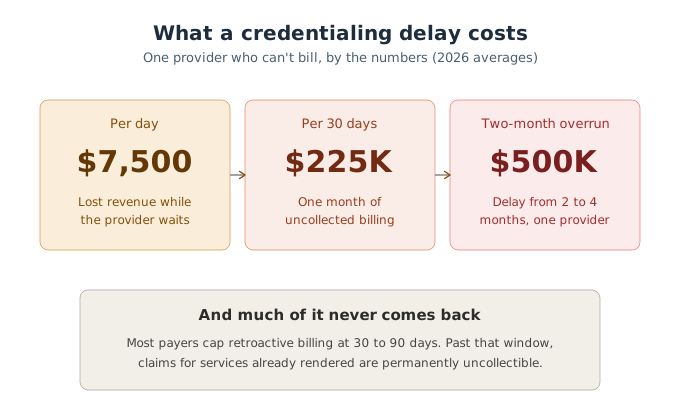
Physicians contribute an average of $200,000 to $300,000 in revenue per month to a practice. That works out to roughly $7,000 to $10,000 per day in revenue contribution that simply doesn’t happen while the provider waits on credentialing. One widely cited 2026 figure puts the average cost of credentialing delays at $7,500 per day in lost billings while a new physician sits unable to see billable patients.
69% of health systems, hospitals, and provider groups report losing $1,000 to $5,000 per provider per day due to payer enrollment delays, according to Medallion’s 2026 State of Payer Enrollment report. The same research found that one in five hospitals that can quantify the impact report losing more than $1 million annually from credentialing delays.
These aren’t worst-case scenarios. They’re averages. The daily cost is real, it accrues every single day the provider isn’t billing, and it doesn’t pause for weekends or holidays.
The Compounding Math of a Two-Month Delay
The daily number is striking, but the way delays compound is what makes them genuinely expensive.
Consider a small practice bringing on a new provider who contributes $250,000 per month in revenue. If credentialing takes two months, that’s the cost of doing business. But if credentialing takes four months instead of two, the additional two-month delay costs approximately $500,000 in unrealized revenue. The difference between a well-run credentialing process and a poorly-run one, for a single provider, is half a million dollars.
The math scales in both directions. A physician billing $500,000 annually who sits idle for four months during credentialing represents roughly $167,000 in lost revenue. A new physician generating $750,000 in charges, translating to about $500,000 in collections, who could start billing two months earlier if credentialing went from 150 days to 90 days, accelerates cash flow by $100,000 or more. Multiply that across five new providers a year, and a practice captures an additional $500,000 simply by tightening its credentialing timeline.
The reason this compounds so severely is that you’re paying full cost the entire time. The provider’s salary, benefits, office space, support staff, equipment, and overhead all run from day one. None of it pauses while credentialing is pending. So a delay isn’t just lost revenue, it’s lost revenue stacked on top of fixed costs that keep accruing.
The Cost That Comes After Approval: Credentialing Lapses
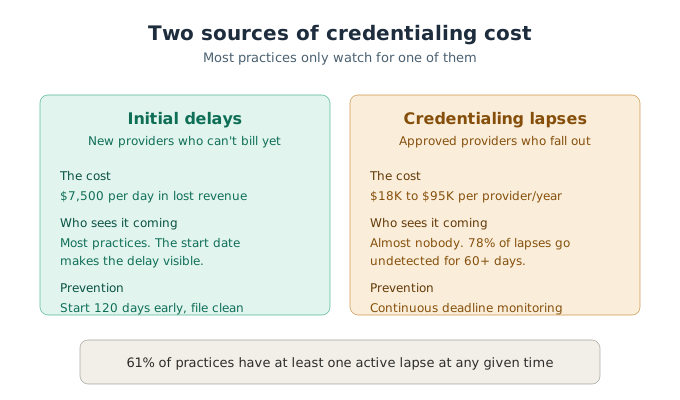
Initial credentialing delays are the obvious cost. The less obvious, and often larger, cost comes from credentialing lapses on providers who were already approved.
A credentialing lapse is a gap in a provider’s active enrollment, caused by a missed revalidation deadline, an expired CAQH attestation, an NPI or taxonomy error, or a practice location change that wasn’t updated. These lapses result in claim denials, payment holds, and revenue loss of $18,000 to $95,000 per affected provider annually.
The frequency is the alarming part. According to MBC’s 2026 analysis across 190 specialty practices, 61% of practices experience at least one active credentialing lapse at any given time, and 78% of those lapses go undetected for 60 or more days. That means most practices are losing revenue to a lapse they don’t even know about, and they won’t find out until denied claims show up in the AR aging report two months later.
The per-lapse cost is concrete. A primary care physician seeing 20 patients per day at $100 per visit can lose roughly $2,000 per day from a lapse with just one insurance carrier, which adds up to about $40,000 over a single month. Multiply that across multiple payers and multiple providers, and a single overlooked deadline becomes a material financial event.
At the 2026 average of $7,500 per day, a 30-day credentialing lapse equals roughly $225,000 in uncollected billing. The fuller picture of why these deadlines get missed and how to prevent them is in our re-credentialing guide.
Is credentialing holding up your revenue?
Every day a provider sits uncredentialed is a day you can’t bill for their work. We take the whole process off your plate.
We handle all of it. Flat $150 per application, all 50 states, with clear status on every provider.
Get My Providers Credentialed → or call (307) 243 2190The Revenue You Can Never Get Back
Here’s the part that makes credentialing delays uniquely painful compared to other revenue problems: much of the lost revenue is permanently unrecoverable.
When a provider sees patients before credentialing is complete, those claims are denied as out-of-network or ineligible. And in most cases, you cannot bill retroactively once credentialing finishes. Those dates of service are lost forever.
Some payers allow retroactive enrollment if the services were medically necessary and the provider was otherwise eligible, but most payers limit this window to 30 to 90 days, and it requires a formal appeal process. Once that window closes, the revenue is simply gone. There is no recovering it through better billing, more aggressive follow-up, or appeals. The only reliable strategy is preventing the gap in the first place.
This is fundamentally different from most AR problems. A denied claim can often be appealed. An aged balance can sometimes still be collected. But revenue lost to a credentialing gap, past the retroactive window, is gone with no recovery path. That permanence is what makes credentialing delays worth preventing at almost any cost.
The Hidden Costs Beyond Lost Billings
The direct revenue loss is the biggest number, but it’s not the only one. Credentialing delays carry several secondary costs that compound the financial damage.
Salary paid against zero revenue. You’re paying the provider, plus benefits, plus overhead, from their start date. If they can’t bill for two months, that’s two months of full compensation with no offsetting income.
Patient attrition. When a new provider’s credentialing drags, patients who booked with them get rescheduled or told to find another doctor. Some never come back, which means you lose immediate revenue plus the future lifetime value of those patient relationships.
Staff time chasing applications. Your administrative team spends hours on hold with payers, checking application status, resubmitting documents, and answering development letters. That’s labor cost diverted from revenue-generating work.
Existing provider strain. When a new provider can’t see patients, the existing providers absorb the overflow, which increases burnout risk and caps the practice’s total capacity at exactly the moment it was trying to expand.
Compliance penalties. Practices operating under managed care contracts tied to NCQA accreditation can face contract penalties on top of the revenue loss from denied claims when credentialing standards aren’t met.
Why 2026 Makes Delays More Expensive
The cost of credentialing delays has risen in 2026 because the environment got stricter on multiple fronts at once.
NCQA tightened its standards. Accredited organizations must now complete credentialing within 120 days, down from the previous 180-day window, and certified organizations face a 90-day limit, reduced from 120 days. Shorter windows mean less tolerance for the document delays and payer back-and-forth that previously had room to absorb.
PECOS 2.0 added real-time validation that catches data inconsistencies instantly, turning what used to be a slow development-letter cycle into an immediate Stay of Enrollment that freezes payments. The full picture is in our PECOS 2.0 guide.
CAQH errors remain the single biggest driver of delays. Industry analysis attributes a large share of credentialing delays to CAQH profile problems, most commonly the 120-day attestation lapses covered in our CAQH ProView guide.
The combined effect is an environment where the same delay costs more than it did even two years ago, because the regulatory windows are tighter and the validation is less forgiving.
The Math That Makes the Decision Obvious
Put all of this together and the financial logic becomes hard to argue with.
If a credentialing mistake delays approval by a single month, the lost revenue from that one month exceeds what most practices would spend on professional credentialing support for an entire year. As one industry analysis put it, paying a credentialing service for a year costs less than a single month of credentialing delay on a productive provider.
Consider a provider seeing 20 patients per day at $150 per visit, generating roughly $3,000 daily or $60,000 monthly. If a credentialing delay means they can only see self-pay patients for two months, the practice loses around $120,000 in insurance reimbursements. Against that, the cost of getting credentialing done right and on time is a rounding error.
This is why experienced practice managers start credentialing 120 days before a provider’s intended start date, not 60 or 30. The buffer isn’t caution for its own sake. It’s the recognition that every day saved on the credentialing timeline is worth thousands of dollars in accelerated revenue, and every day lost is worth the same in the other direction.
How to Reduce the Cost
The cost of credentialing delays is largely preventable. The practices that minimize it share a few habits.
Start early. Begin credentialing 120 days before the provider’s intended start date. The buffer absorbs the inevitable development letters and payer delays without pushing past the start date. The full timeline breakdown is in our credentialing timeline guide.
Submit clean the first time. Most delays come from preventable errors: data mismatches, expired documents, incomplete CAQH profiles, unexplained work history gaps. A clean first submission is the single biggest lever on timeline. The common failure modes are in our credentialing denial reasons guide.
Monitor continuously. The 78% of lapses that go undetected for 60+ days are detectable with active monitoring. Tracking attestation dates, revalidation deadlines, and document expirations turns surprise lapses into scheduled renewals.
Assign one owner. Distributed credentialing responsibility is where deadlines slip. One person, internal or outsourced, owning the full calendar across every provider and payer eliminates the gaps that cause lapses.
Frequently Asked Questions
Credentialing delays cost an average of $7,500 per day in lost revenue in 2026, with most health systems reporting losses of $1,000 to $5,000 per provider per day from payer enrollment delays. The exact figure depends on the provider’s specialty and patient volume, but for most physicians the daily cost runs into the thousands.
Rarely in full. Some payers allow retroactive enrollment if services were medically necessary and the provider was otherwise eligible, but most limit this window to 30 to 90 days and require a formal appeal. Once that window closes, the revenue is permanently lost. Prevention is the only reliable strategy.
Credentialing lapses cause revenue loss of $18,000 to $95,000 per affected provider per year. A single lapse with one payer can cost roughly $2,000 per day, or about $40,000 over a month, for a typical primary care physician. Across multiple payers and providers, annual exposure can reach into six figures per provider.
NCQA tightened credentialing windows (120 days for accredited organizations, down from 180), PECOS 2.0 added real-time validation that freezes payments on any data inconsistency, and payers are processing higher application volumes with stricter rules. The same delay now carries higher cost because the regulatory environment is less forgiving.
For practices losing revenue to delays and lapses, outsourcing usually costs far less than the revenue it protects. A month of credentialing delay on a productive provider typically costs more than a full year of professional credentialing support. The decision turns on how much revenue your current process is leaving on the table.
Stop Paying for Credentialing Delays You Can Prevent
Credentialing delays are one of the largest preventable revenue losses in a healthcare practice. The provider can’t bill, the salary still gets paid, the patients drift away, and much of the lost revenue can never be recovered. The cost runs into six figures per provider per year, and in 2026’s tighter regulatory environment, it’s only getting larger.
MedBillingTech handles credentialing and re-credentialing for solo providers, group practices, and telehealth networks across all 50 states. Flat fee of $150 per application, with primary source documentation, payer follow-up, continuous deadline tracking, and lapse prevention included. Sixteen-plus years of payer enrollment experience.
Get Started With Credentialing →
If you want to know where your current credentialing exposure sits before deciding anything, the free CredReady audit reviews your credentialing posture across all major payers, flags the gaps most likely to be costing you revenue right now, and produces a personalized report in 15 minutes.
Or call (307) 243 2190 to talk through what credentialing delays may be costing your practice.