A practice owner finishes incorporating, hires their first associate provider, and starts submitting claims under the same NPI they’ve been using as a solo for years. The first batch of claims comes back denied. The payer’s reason code points to an NPI/Tax ID mismatch. Six weeks later, after frantic correction requests and an emergency NPPES application, the practice finally has the second NPI it actually needed all along, and is trying to recover the AR that aged out in the meantime.
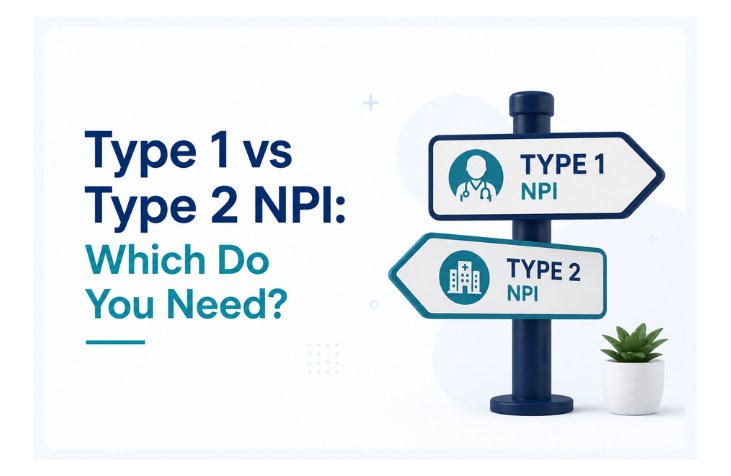
This is one of the most common credentialing mistakes in healthcare, and it comes from a single misunderstanding: the National Provider Identifier (NPI) is not one thing. There are two types, Type 1 and Type 2, and most providers eventually need both. Getting them confused or trying to bill with the wrong one causes denials that are easy to avoid but expensive to fix.
This post breaks down what each NPI type actually is, who needs which, how they work together, and the mistakes that delay claims.
What a Type 1 NPI Is
A Type 1 NPI is a unique 10-digit identification number assigned to an individual healthcare provider by NPPES, the National Plan and Provider Enumeration System. It identifies the person who renders the service, regardless of where they work or who they work for. A physician, nurse practitioner, dentist, therapist, or any other licensed clinician who provides healthcare services to patients needs a Type 1 NPI.
Three things make a Type 1 NPI distinctive:
It is permanent. Once issued, a Type 1 NPI stays with the provider for life, even if they change practices, switch states, change specialties, or move to an entirely different setting. The provider keeps the same number through every job change.
There is exactly one per person. A provider cannot hold multiple Type 1 NPIs. The number is tied to the individual, not to any role, location, or organization. The same Type 1 NPI is used everywhere the provider works.
It identifies who did the work, not who gets paid. When a claim is submitted, the Type 1 NPI in the rendering provider field tells the payer which clinician actually delivered the service. This stays true whether the provider bills under their own name or under a group’s name.
What a Type 2 NPI Is
A Type 2 NPI is a unique 10-digit identification number assigned to a healthcare organization, group practice, or business entity. It identifies the legal entity that bills for services, not any individual person. A Type 2 NPI is sometimes called the group NPI, organizational NPI, or billing NPI.
Any healthcare entity that bills payers as an organization rather than as an individual needs a Type 2 NPI. This includes:
- Group practices (any practice incorporated as a separate legal entity)
- Hospitals and hospital systems
- Clinics, ambulatory surgery centers, and outpatient facilities
- Home health agencies, hospice organizations, and DMEPOS suppliers
- Behavioral health agencies and rehabilitation facilities
- Solo providers who have incorporated their practice as an LLC, PC, or S-Corp
The last point catches many providers off guard. A solo physician who initially billed under their own Type 1 and Social Security Number can keep doing exactly that. But the moment they incorporate their practice, the practice itself becomes a separate legal entity with its own Tax ID, and that entity needs a Type 2 NPI to bill payers under the corporate name.
Type 2 NPIs are also permanent for the entity they identify, but unlike Type 1, an organization may need more than one. If a multi-location practice has different Tax IDs for different locations, each location needs its own Type 2 NPI.
How Type 1 and Type 2 NPIs Work Together
For group practices, both NPI types appear on every claim, and each plays a specific role. The Type 1 NPI in the rendering provider field tells the payer which clinician delivered the service. The Type 2 NPI in the billing provider field tells the payer which entity should be paid for that service.
This split is what makes group billing work. A physician at a 10-provider group submits claims using their own Type 1 NPI (so the payer knows who treated the patient), but those claims pay to the group’s Type 2 NPI under the group’s Tax ID. The provider’s Type 1 NPI stays the same whether they work at this group, switch to another group next year, or open their own practice. The group’s Type 2 NPI stays the same whether providers come and go.
For this to function cleanly, the link between the two has to be established with each payer through a process called reassignment of benefits. The provider is effectively telling the payer, “send my Medicare and commercial reimbursements to this group’s Tax ID for services I render at this location.” For Medicare specifically, this happens through the reassignment action on the CMS-855I (the standalone CMS-855R was discontinued in late 2023). The full mechanics of how this works in group practice credentialing are covered in our group practice credentialing guide.
Who Needs Which NPI
The decision logic is straightforward once the structure is clear:
Solo provider, not incorporated, billing under your own SSN or EIN: Type 1 only. You are the practice for billing purposes.
Solo provider who incorporates as an LLC, PC, or S-Corp: Type 1 + Type 2. You still need your individual Type 1, and the corporate entity needs its own Type 2.
Multi-provider group practice: Type 2 for the group, plus a Type 1 for each provider in the group. Every claim uses both.
Multi-location group with separate Tax IDs per location: Type 1 for each provider, plus a separate Type 2 for each location with its own Tax ID.
Hospitals, agencies, facilities: Type 2 for the institution. Type 1 for each individual practitioner who provides services there and bills under their own name (versus those who are W-2 employees billed entirely under the institution).
How to Apply for an NPI
Both Type 1 and Type 2 NPIs are free and issued through the NPPES website. The application takes about 15 to 20 minutes once you have the required information ready. Most NPIs are assigned within 10 business days, sometimes within 24 to 72 hours.
For a Type 1, you need legal name, date of birth, Social Security Number, primary practice address, taxonomy code (specialty), and contact information.
For a Type 2, you need the organization’s legal business name as filed with the IRS, EIN, business address, authorized official information, taxonomy code, and contact details. The authorized official is the person legally allowed to act on behalf of the entity.
Once issued, both NPIs should be verified in the NPI Registry and reflected accurately in CAQH, PECOS, and every payer enrollment. Mismatches between the NPI registry and other systems are one of the single most common causes of credentialing denial.
Is credentialing holding up your revenue?
Every day a provider sits uncredentialed is a day you can’t bill for their work. We take the whole process off your plate.
We handle all of it. Flat $150 per application, all 50 states, with clear status on every provider.
Get My Providers Credentialed → or call (307) 243 2190Common NPI Mistakes That Delay Claims
A handful of NPI mistakes account for most of the avoidable claim denials in group practices. The one we see most is a newly incorporated solo practice still billing under the owner’s Type 1 and personal Tax ID, months after the entity needed its own Type 2.
Billing under the wrong NPI. Submitting claims with the Type 1 NPI in the billing provider field, or the Type 2 NPI in the rendering provider field, generates rejections that are easy to fix but expensive in time.
Not getting a Type 2 when incorporating. A solo provider who incorporates their practice without applying for a Type 2 will continue billing under their personal Tax ID, which conflicts with their corporate IRS filings and creates compliance issues at year-end.
Failing to update NPPES within 30 days of changes. Address changes, name changes, taxonomy updates, and entity restructuring all need to be reflected in NPPES within 30 days. Outdated NPPES data triggers automated flags in payer systems and stalls applications.
Taxonomy code mismatches. The taxonomy code in NPPES, CAQH, and PECOS must match. A provider whose NPPES taxonomy reads family medicine but whose payer enrollment reads internal medicine will see claims and credentialing applications flagged.
Forgetting to link Type 1 to Type 2 with each payer. The NPIs existing in NPPES does not automatically link them with every payer. The reassignment of benefits process has to happen separately with Medicare, Medicaid, and every commercial payer. Skipping this step leaves the Type 1 unlinked, and claims either pay to the wrong entity or deny outright.
Frequently Asked Questions
A Type 1 NPI is for an individual healthcare provider, identifying the person who delivers care. A Type 2 NPI is for an organization or group practice, identifying the legal entity that bills for services. The two work together on group claims: Type 1 identifies who rendered the service, and Type 2 identifies who gets paid.
Yes, and many do. A solo provider who incorporates their practice will need a Type 1 (for themselves as the provider) and a Type 2 (for the corporate entity that bills). Both stay active simultaneously and are used in different fields on the same claim.
Most NPIs are assigned within 10 business days of submitting a complete application through NPPES, and sometimes within 24 to 72 hours. The application itself takes about 15 to 20 minutes.
No. Both Type 1 and Type 2 NPIs are permanent identifiers. Once assigned, they stay with the provider or organization for life, even through job changes, address changes, or specialty changes. However, the information connected to the NPI (address, taxonomy, business name) must be kept current in NPPES through updates filed within 30 days of any change.
Claims submitted with the wrong NPI in the wrong field are typically denied or rejected. The fix is usually straightforward (resubmit with the correct NPI structure), but the delay can run two to four weeks per affected claim. Recurring NPI errors point to a billing setup problem that needs to be corrected at the workflow level, not claim by claim.
Get Your NPI Setup Right the First Time
NPI mistakes are among the most preventable causes of claim denials, but they’re also among the most common, because the two-type structure is rarely explained clearly when providers first set up their practice. A wrong NPI on a claim is fixable. A wrong NPI structure across an entire billing operation costs weeks of revenue before anyone notices.
MedBillingTech handles NPI registration, NPPES updates, and credentialing setup as part of our flat-fee credentialing service ($150 per application). We’ve handled NPI work for solo providers, group practices, and multi-location entities across all 50 states.
Get Started With Credentialing →
If you want a quick check on whether your current NPI setup is correct, free credentialing audit reviews NPI alignment alongside CAQH, PECOS, and payer enrollment posture in 15 minutes.