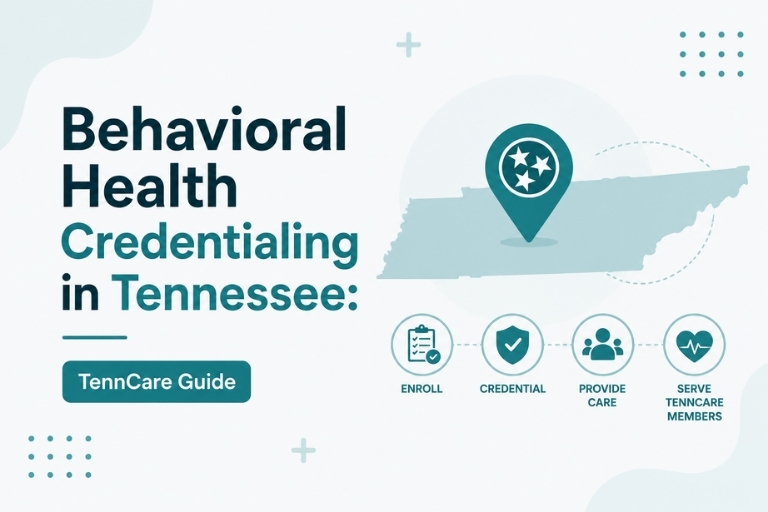
Behavioral health credentialing in Tennessee runs through a managed care model where nearly every Medicaid dollar flows through one of three private plans, not the state directly. If you run a behavioral health practice in Tennessee and want to see TennCare members, getting enrolled with the state is only the first step. The step that actually lets you bill is contracting with the managed care organizations, and that’s where most of the timeline and most of the friction live.
Tennessee also does one thing differently from most states, and it works in your favor: it does not carve out behavioral health into a separate panel. Where a provider in many states has to credential separately with a behavioral health entity like Optum, Tennessee folds physical, behavioral, and pharmacy benefits into a single MCO contract. That’s one fewer layer to manage, but it comes with its own rules worth understanding before you start.
This post walks through how behavioral health credentialing actually works in Tennessee, on both the TennCare and commercial sides, and what trips practices up.
How TennCare Is Structured
TennCare is Tennessee’s Medicaid program, and it has operated as a fully managed care program since 1994, with no traditional fee-for-service option. Medical, behavioral, and long-term care services are all covered by at-risk Managed Care Organizations, and each MCO creates its own provider contracts, maintains its own fee schedule, and processes its own claims.
There are three TennCare MCOs statewide:
- BlueCare Tennessee, operated by Volunteer State Health Plan, an affiliate of BlueCross BlueShield of Tennessee
- UnitedHealthcare Community Plan of Tennessee
- Wellpoint Tennessee, formerly Amerigroup
A fourth entity, TennCare Select, is operated by BlueCare under a separate contract and covers special populations including SSI children, foster care youth, and members with intellectual and developmental disabilities.
The at-risk model matters for how you get paid. The state pays each MCO a capitated amount, and the MCO decides what it pays providers. Because rates are negotiated per MCO rather than set by the state, two practices billing the same code in the same city can be paid different amounts. There is no single statewide behavioral health rate to look up. Your rate is whatever your contract’s fee exhibit says.
The Two-Layer Enrollment Process
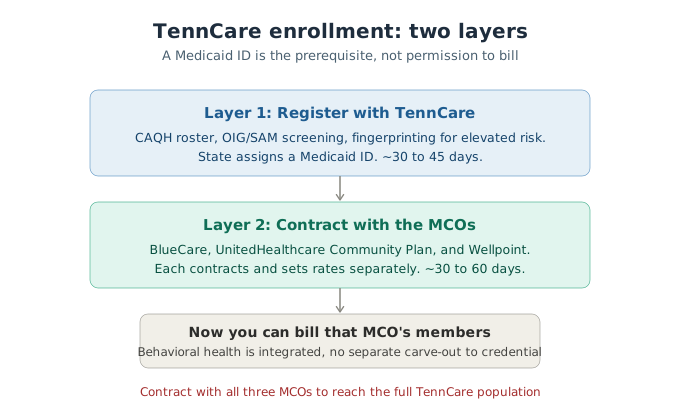
Getting to the point where you can bill TennCare for behavioral health services takes two distinct steps, and skipping or misordering them is the most common mistake.
Layer one: register with TennCare. Individual providers must register electronically with TennCare through the Provider Registration portal, which places the provider on the CAQH roster for TennCare. The state pulls your data from the CAQH Universal Provider Datasource, clears you against OIG and SAM exclusion databases, runs fingerprint-based background checks for elevated-risk categories, and once your CAQH-attested data is received and approved, assigns you a Medicaid ID. This is the state validation layer.
Layer two: contract with the MCOs. Getting a Medicaid ID from the state is the prerequisite, not the finish line. To actually bill for services, you have to execute a contract with each MCO whose members you want to see. Each MCO runs its own contracting process, its own credentialing committee, and its own fee negotiation. A provider registered with TennCare but not contracted with any MCO still can’t bill anyone.
The full timeline typically runs 60 to 105 days: roughly 30 to 45 days for state portal approval, followed by 30 to 60 days for MCO contracting. The two layers can’t be fully parallelized, since MCO contracting depends on state registration being complete.
Because the underlying data flows through CAQH, keeping that profile complete and attested is foundational. The same discipline covered in our guide to maintaining your CAQH ProView profile applies directly, since a lapsed attestation stalls the whole TennCare process at layer one.
Not sure where your TennCare enrollment stands?
The audit maps your Tennessee enrollment across both layers and every MCO, so you know exactly what’s done and what’s missing:
No Behavioral Health Carve-Out: Why That Matters
Here’s the structural detail that sets Tennessee apart. Tennessee integrates physical, behavioral, and pharmacy services under single MCO contracts, with no separate behavioral health carve-outs.
In most states, behavioral health is carved out to a separate managed behavioral health organization, meaning a therapist has to credential with a distinct behavioral health entity separate from the medical plan, as we cover in our guide to what makes behavioral health credentialing different. Tennessee doesn’t do this. When you contract with BlueCare, UnitedHealthcare Community Plan, or Wellpoint, that single contract covers behavioral health services alongside everything else the MCO administers.
For a behavioral health group, this is genuinely simpler. You’re negotiating with three MCOs, not three MCOs plus three separate behavioral health carve-out entities. The tradeoff is that behavioral health sits inside a general medical contract, so you need to confirm that your specific behavioral health service codes, provider types, and prior authorization requirements are addressed in the contract rather than assumed. Integrated does not mean automatic.
The Commercial Side
Alongside TennCare, most Tennessee behavioral health practices also want to be in-network with commercial payers. Commercial behavioral health credentialing in Tennessee follows the national pattern rather than the TennCare model.
On the commercial side, the carve-out structure that Tennessee Medicaid avoids often reappears. Commercial UnitedHealthcare behavioral health is administered through Optum, and other national commercial payers may route behavioral health through their own managed behavioral health arms. So a Tennessee practice can end up managing an integrated model for TennCare and a carved-out model for the same insurer’s commercial line. Confirming which structure applies to each commercial contract, before you file, prevents the assumption errors that cause denials.
BlueCross BlueShield of Tennessee is typically the anchor commercial payer for a Tennessee practice given its market share, alongside commercial UnitedHealthcare, Aetna, and Cigna. Each runs standard commercial credentialing off your CAQH profile, on the 60-to-120-day timelines that apply to commercial behavioral health nationally.
What Trips Tennessee Practices Up
A few recurring issues account for most of the delays in Tennessee behavioral health credentialing.
Stopping at state registration. The most common error is assuming that getting a TennCare Medicaid ID means you can bill. It doesn’t. Without an executed MCO contract, the Medicaid ID is just a prerequisite. Practices sometimes wait weeks wondering why claims deny before realizing they never contracted with the MCO.
Data mismatches at layer one. Specialty codes have to match your federal NPPES documentation exactly, or the automated system places a hold. Taxonomy and name mismatches between NPPES, CAQH, and the TennCare portal stall registration before it reaches a human.
Not contracting with all three MCOs. Members are distributed across BlueCare, UnitedHealthcare, and Wellpoint, and a member’s MCO determines who pays for their care. A practice contracted with only one MCO can only bill that MCO’s members. To see the full TennCare population, you generally need all three.
Missing revalidation. TennCare enrollment must be revalidated every three years, and missing it results in termination from the program. Reinstatement means starting over, so tracking the revalidation date across your whole roster matters.
Confusing integrated with automatic. Because TennCare has no behavioral health carve-out, practices sometimes assume behavioral health services are automatically covered under any MCO contract. The integration simplifies the structure, but you still need to confirm your behavioral health codes and authorization requirements are correct in each contract.
Frequently Asked Questions
Enrollment takes two steps. First, register electronically with TennCare through the Provider Registration portal, which places you on the CAQH roster, clears you against federal exclusion databases, and assigns a Medicaid ID once your CAQH data is approved. Second, contract separately with the TennCare MCOs (BlueCare, UnitedHealthcare Community Plan, and Wellpoint) whose members you want to see. Both steps are required before you can bill.
No. Tennessee integrates physical, behavioral, and pharmacy services under single MCO contracts, so there is no separate behavioral health entity to credential with. When you contract with a TennCare MCO, that contract covers behavioral health alongside other services. This is simpler than the carve-out model many other states use, though you should confirm your behavioral health codes and authorization rules are addressed in each contract.
Typically 60 to 105 days total: roughly 30 to 45 days for state portal registration and approval, followed by 30 to 60 days for MCO contracting. The two phases can’t be fully run in parallel because MCO contracting depends on completed state registration. Data mismatches or an incomplete CAQH profile can extend the timeline.
There are three statewide TennCare MCOs: BlueCare Tennessee, UnitedHealthcare Community Plan of Tennessee, and Wellpoint (formerly Amerigroup). TennCare Select, run by BlueCare, covers special populations. Because members are distributed across the three MCOs, most practices contract with all three to reach the full TennCare population, since you can only bill for members enrolled in an MCO you’re contracted with.
Yes. TennCare enrollment must be revalidated every three years to avoid termination from the program. A missed revalidation means reinstatement from scratch, so tracking each provider’s revalidation date across your roster is essential, especially for a group with multiple clinicians on different cycles.
Get Enrolled in Tennessee Without the Guesswork
Tennessee behavioral health credentialing is more navigable than most states thanks to the integrated MCO model, but the two-layer process still catches practices that assume a Medicaid ID is enough to bill. Getting registered with TennCare and contracted with all three MCOs, cleanly and in the right order, is the difference between billing in two months and chasing denials for six.
MedBillingTech handles behavioral health credentialing across Tennessee, TennCare registration, MCO contracting with BlueCare, UnitedHealthcare, and Wellpoint, and commercial payer enrollment, for solo clinicians and growing groups. Flat fee of $150 per application, with CAQH management and revalidation tracking included. Sixteen-plus years of payer enrollment experience.
Get Started With Credentialing →
If you want to see where your Tennessee enrollments currently stand across TennCare and commercial payers, the free CredReady audit maps every provider’s status and flags the gaps in 15 minutes.
Or call (307) 243 2190 to talk through your Tennessee credentialing.