A physician sits in Illinois and sees a patient over video. The patient is in Arizona. Which state does the physician need to be licensed in? The answer trips up more telehealth practices than any other rule in credentialing, and getting it wrong means disciplinary risk, malpractice coverage gaps, and claims that deny at a 100% rate until the problem is fixed.
The answer is Arizona. A provider must be licensed in the state where the patient is physically located at the time of the visit, not where the provider is sitting.
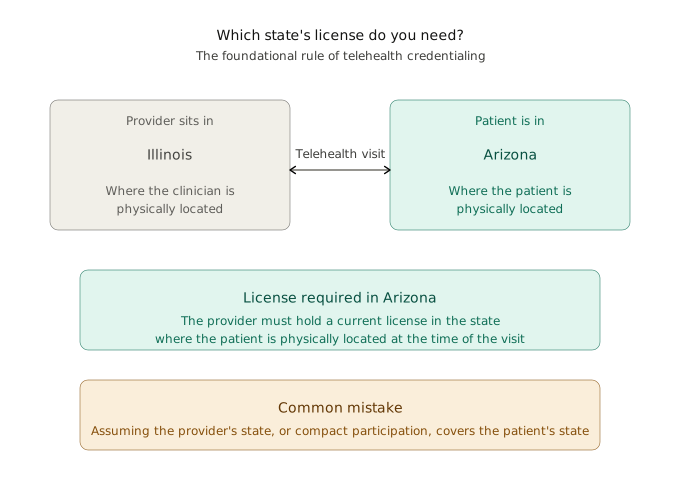
This rule applies universally across Medicare, Medicaid, and commercial payers, and it’s the foundation that every telehealth credentialing decision is built on.
For a single-state practice, telehealth credentialing isn’t much different from regular credentialing. For a practice that wants to see patients across state lines, it becomes a licensing strategy problem before it’s a credentialing problem. You can’t credential a provider with a payer in a state where that provider isn’t licensed, so the license has to come first, and licenses are the slowest, most expensive part of the whole equation.
Telehealth credentialing is the multi-state version of standard provider credentialing. If you’re not already familiar with the core process, the complete guide is the place to start.
This post walks through how telehealth credentialing actually works in 2026, how the licensure compacts help (and where they don’t), what trips practices up, and how to build a multi-state strategy that doesn’t consume your entire administrative capacity.
The One Rule That Governs Everything
The provider must hold a valid license in the state where the patient is located at the time of the telehealth visit. Everything else in telehealth credentialing follows from this single principle.
This rule applies universally to Medicare, Medicaid, and commercial payers. A physician licensed only in Illinois cannot legally treat a patient sitting in Arizona over video, even if the visit is clinically identical to one with an Illinois patient. The patient’s physical location at the moment of the encounter determines which state’s license is required.
The consequences of getting this wrong are not minor. Practicing without the correct state license exposes the provider to disciplinary action from state medical boards, creates malpractice coverage gaps (most policies won’t cover care delivered without proper licensure), and results in claim denials. Payers verify licensure against the service location, and a mismatch means the claim doesn’t pay.
For a telehealth practice that wants to reach patients in multiple states, this creates an immediate and expensive problem: you need a license in every state where you intend to have patients. That’s where the licensure strategy starts, and where the compacts become essential.
How the Licensure Compacts Actually Work
Licensure compacts are agreements between member states that make it faster for a provider to get licensed in multiple states, but they are not national licenses. This distinction is the single most misunderstood part of telehealth credentialing, and misunderstanding it causes real compliance problems.
The most prominent compact for physicians is the Interstate Medical Licensure Compact (IMLC). Currently 42 states plus Washington D.C. and Guam participate. Here’s how it works: a physician with a full, unrestricted license in their State of Principal License applies through the IMLC portal, and the compact issues expedited licenses in other participating states without making the physician repeat the entire application from scratch each time.
What the IMLC does: it cuts the licensing timeline dramatically, often to 14 to 21 days per state instead of the months a traditional application can take. It makes multi-state expansion administratively feasible. It’s ideal for telehealth-focused practices building a footprint across many states.
What the IMLC does not do: it does not create a single license that works everywhere. Each state still issues, renews, and regulates its own license. A physician who gets ten state licenses through the IMLC still holds ten separate licenses, each with its own renewal date, its own fees, and its own regulatory authority. The compact is a faster on-ramp, not a replacement for state-by-state licensure.
Different provider types have different compacts:
- Physicians: Interstate Medical Licensure Compact (IMLC)
- Nurses: Nurse Licensure Compact (NLC), which uses a multistate license model
- Psychologists: PSYPACT, the furthest-developed compact for telehealth, though annual PSYPACT authorization renewal fees are increasing starting January 1, 2026
- Physician Assistants: the newer PA Licensure Compact, which uses a compact-privilege model
- Physical therapists, occupational therapists, counselors, social workers, audiologists: each has its own compact at various stages of implementation
The compact model differs by profession. Some, like the Nurse Licensure Compact and PSYPACT, use a privilege-to-practice model where your home-state license extends to member states. Others, like the IMLC, use an expedited-licensing model where you still get separate licenses, just faster. Knowing which model applies to your provider type is the starting point for any multi-state strategy.
The Mistake That Causes the Most Trouble
The single most common error in telehealth credentialing is assuming compact participation equals national coverage. It doesn’t, and the assumption leads directly to compliance problems.
Assuming compact privilege translates to national coverage can lead to compliance issues, licensing denials, or claim denials. A practice that believes “we’re in the IMLC, so we’re covered nationally” will eventually treat a patient in a state where the provider doesn’t actually hold a license, because the compact made it easy to get many licenses but didn’t issue licenses in states the practice never applied to.
The fix is precise tracking. For every provider, you need to know exactly which states they hold an active license in, when each license expires, and whether the states they’re treating patients in match the states they’re licensed in. A telehealth practice treating patients in 20 states needs to confirm that every provider seeing those patients holds a current license in each relevant state, not just that they’re “in the compact.”
This is compounded by the fact that telehealth patients move. A patient who established care while physically in Texas might take a video visit while traveling in Colorado. If the provider isn’t licensed in Colorado, that visit is a problem. Practices serving mobile or traveling patient populations need a way to confirm patient location at the time of each visit, not just at intake.
Is credentialing holding up your revenue?
Every day a provider sits uncredentialed is a day you can’t bill for their work. We take the whole process off your plate.
We handle all of it. Flat $150 per application, all 50 states, with clear status on every provider.
Get My Providers Credentialed → or call (307) 243 2190How Telehealth Credentialing Differs From Standard Credentialing
Telehealth credentialing runs every step of normal credentialing, just multiplied across states and with a few telehealth-specific wrinkles layered on top. The underlying work (primary source verification, CAQH, payer enrollment) is the same. What changes is the scale and a handful of added requirements.
The license multiplication problem is the biggest difference. A single-state provider deals with one state license. A telehealth provider practicing in 15 states deals with 15 state licenses, each requiring separate application, separate verification, separate renewal tracking, and separate fees. Every one of those licenses then has to be reflected accurately in the provider’s CAQH profile, PECOS record, and each payer enrollment.
Payer enrollment also multiplies. Being licensed in a state isn’t the same as being enrolled with that state’s payers. A provider licensed in 15 states still has to enroll with Medicare, Medicaid, and the relevant commercial payers in each of those states. The 90-day credentialing timeline applies in every state separately, which is why telehealth credentialing is fundamentally a parallel-processing exercise.
There’s a bright spot: telehealth-only credentialing through dedicated telehealth networks is often the fastest path in the industry, sometimes 15 to 45 days. Telehealth networks have streamlined processes built specifically for remote providers. For practices working through these networks rather than enrolling directly with every payer in every state, the timeline can be dramatically shorter.
Telehealth-specific supplemental requirements also appear. Some payers have separate telehealth attestations, technology platform disclosures, or modality-specific forms. Behavioral health telehealth in particular often has its own enrollment process distinct from the standard application. Always confirm with each payer whether telehealth services require anything beyond the standard credentialing packet.
Building a Multi-State Telehealth Strategy
A workable multi-state telehealth credentialing strategy comes down to deciding which states matter, using the right compact, and tracking everything in one place. Here’s the sequence that works.
Start with the states, not the payers. Map out where your patients actually are or will be. Don’t license in states speculatively; licenses cost money and require renewal. License in the states where you have real patient demand, and add states as demand materializes.
Use the compact that fits your provider type. For physicians, route multi-state licensing through the IMLC to cut the timeline. For nurses, use the Nurse Licensure Compact’s multistate license. For psychologists, PSYPACT. Match the pathway to the provider type before filing anything.
License first, then enroll. You can’t enroll with a payer in a state where the provider isn’t licensed. Sequence the work: state license, then CAQH update to reflect the new license, then payer enrollment in that state. Trying to run these in the wrong order produces denials.
Reconcile every license across systems. Each new state license has to appear in the provider’s CAQH profile, NPPES where relevant, and every affected payer enrollment. A license that exists but isn’t reflected in CAQH does the provider no good for commercial payer credentialing in that state.
Track renewals relentlessly. Fifteen state licenses means fifteen renewal dates, fifteen sets of continuing education requirements, and fifteen potential lapses. A lapsed license in one state means every patient in that state is suddenly being seen by an unlicensed provider. The renewal tracking burden scales linearly with the number of states, and it never stops.
Confirm patient location at each visit. Build a workflow that verifies where the patient is physically located at the time of the visit, not just their home address. This protects against the traveling-patient problem and is increasingly something payers and boards expect practices to document.
When the Tracking Burden Outgrows Your Team
For a provider licensed in two or three states, internal tracking with a good spreadsheet is manageable. The math changes fast as states are added. Organizations expanding to 10, 20, or 50 states benefit from outsourcing licensing and credentialing to specialists, because the volume of licenses, renewals, payer enrollments, and cross-system reconciliation exceeds what a general administrative role can hold accurately.
What an outsourced partner provides for telehealth specifically: managing the IMLC or other compact applications, tracking every state license and its renewal date, handling payer enrollment in each state, keeping CAQH and PECOS reconciled across all the licenses, and watching for the lapses that would otherwise surface only when claims start denying. The work scales with the number of states, and at a certain point dedicating internal staff to it costs more than the alternative.
The same patterns that govern single-state credentialing, re-credentialing, and PECOS enrollment all still apply in telehealth. Telehealth just multiplies them across every state line you cross.
Frequently Asked Questions
Yes. A provider must hold a valid license in the state where the patient is physically located at the time of the visit. This applies to Medicare, Medicaid, and commercial payers alike. A provider licensed only in their home state cannot legally treat patients located in other states, regardless of where the provider is sitting during the visit.
No. The IMLC is an expedited pathway to obtain separate licenses in multiple states faster, not a single national license. Each of the 42 participating states (plus DC and Guam) still issues, renews, and regulates its own license. A physician who obtains ten licenses through the IMLC holds ten separate state licenses, each with its own renewal date and fees.
It depends on the path. Obtaining a state license through the IMLC typically takes 14 to 21 days per state, much faster than a traditional application. Credentialing through a dedicated telehealth network can run 15 to 45 days. Enrolling directly with Medicare, Medicaid, and commercial payers in each state follows the standard 90 to 120 day credentialing timeline, multiplied across every state.
Assuming that participating in a licensure compact provides national coverage. It doesn’t. A practice that believes being “in the compact” covers them everywhere will eventually treat a patient in a state where the provider holds no license, which triggers claim denials and compliance risk. Precise state-by-state license tracking is the only reliable safeguard.
Several. Nurses use the Nurse Licensure Compact, psychologists use PSYPACT, physician assistants use the newer PA Licensure Compact, and physical therapists, occupational therapists, counselors, social workers, and audiologists each have their own compacts at various stages of implementation. The model varies: some grant a privilege to practice in member states, while others expedite separate state licenses.
Multi-State Telehealth Credentialing, Handled
Telehealth opens your practice to patients across the country, but only if every provider holds the right license in the right state and stays enrolled with the right payers. The licensing and tracking burden scales with every state line you cross, and a single lapsed license can turn an entire state’s patients into denied claims overnight.
MedBillingTech handles telehealth credentialing and multi-state licensing for solo providers, group practices, and virtual-first organizations across all 50 states. Flat fee of $150 per application, with compact application support, state license tracking, multi-state payer enrollment, and CAQH and PECOS reconciliation included. Sixteen-plus years of payer enrollment experience.
Get Started With Credentialing →
If you want to see where your current multi-state licensing and credentialing stands first, the free CredReady audit flags license gaps, enrollment mismatches, and renewal risks in 15 minutes.
Or call (307) 243 2190 to talk through your multi-state strategy.