A new provider joins your group practice on March 1. They start seeing patients on day one because you didn’t realize credentialing was different for groups than for solos. The first claims go out the door, and a week later they start coming back. The provider isn’t enrolled with most of your payers under the group’s tax ID. Some claims deny entirely. Others process under the wrong provider link and get reversed later. By the time you catch the pattern, six weeks of revenue is in question.
This is the most common mistake practices make when expanding. Group practice credentialing isn’t a single process — it’s two parallel tracks running on different timelines, with different forms, different effective dates, and different consequences when something goes wrong. Solo providers have one credentialing track. Group practices have two. Most of the confusion in adding a new provider comes from not understanding which track does what.
This post covers the group-specific mechanics. For how credentialing works at the individual level first, see our complete guide to provider credentialing.
If you’re running a group, adding clinicians, or moving from solo to group structure, this post walks through what actually changes, what’s faster than fresh credentialing, what’s not, and what to do in the weeks before a new provider’s start date so the first claim pays clean.
The Two Tracks of Group Practice Credentialing
Group practice credentialing runs on two parallel tracks: organizational credentialing that establishes the group as a billable entity with its own Type 2 NPI, and individual credentialing for each provider with their own Type 1 NPI. Both have to be complete and linked correctly before claims pay. Solo credentialing is simple in concept. One provider, one NPI, one enrollment per payer. The provider is the practice for billing purposes.
A group practice splits this into two parallel structures. The group is one entity, the providers are separate entities, and both have to be credentialed and linked correctly for claims to pay.
Organizational credentialing establishes the group itself as a billable entity. The group has its own Tax Identification Number, its own Type 2 NPI (the organizational NPI, sometimes called the group NPI), its own malpractice coverage, and its own contracts with each payer. When the group is credentialed, the payer recognizes the practice as a contracting entity that can submit claims.
Individual provider credentialing runs alongside it. Each provider in the group has their own Type 1 NPI (the individual NPI), their own state license, their own DEA, their own malpractice coverage, and their own credentialing review with each payer. Even in a 30-physician group, every individual provider goes through individual credentialing. There are no shortcuts for volume — each provider has to be separately verified by each payer.
The link between the two tracks is what makes group practice credentialing work. Each provider’s Type 1 NPI has to be actively linked to the group’s Type 2 NPI within each payer’s system. That link is what tells the payer “when this provider renders services at this group, submit claims under the group’s tax ID and pay the group, not the individual.”
When the link is missing or broken, claims either deny or get paid to the wrong entity. When the link is in place, the system works invisibly — which is why most practice owners don’t notice it exists until something breaks.
The Structural Advantage Most Groups Don’t Realize
Before getting into the mechanics of adding a provider, it’s worth understanding why group practice credentialing is structurally better than purely individual arrangements for practices managing turnover.
Under a properly structured group enrollment, when a provider leaves, the practice’s payer contracts and network participation stay intact. The departing provider’s Type 1 NPI is unlinked from the group, but the group’s Type 2 NPI, contracts, and reimbursement rates remain. Only one piece — the individual provider link — has to change. Onboarding the replacement provider is a roster update, not a fresh contract negotiation.
In a structure where each provider is credentialed individually (with no group enrollment), the payer contract is tied to that specific provider. When they leave, they take the network participation with them, and the group has to start the credentialing process over for their replacement. For groups managing any meaningful provider turnover, this distinction has direct revenue implications.
If you’re operating as a group but credentialing individually for some reason, that’s an architectural problem worth fixing before adding more providers.
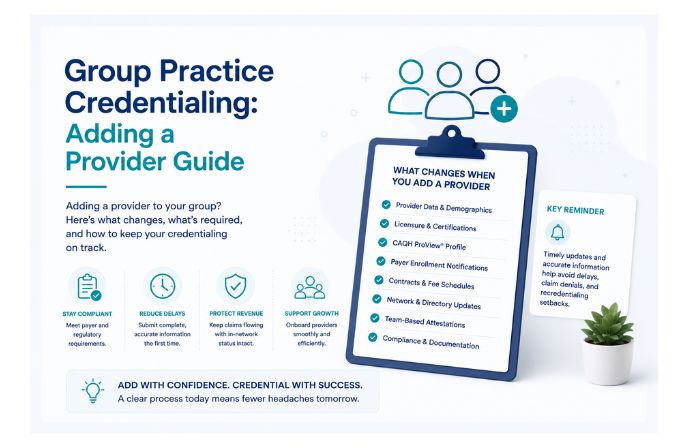
What Changes When You Add a New Provider
Here’s where the practical work happens. Adding a new provider to a credentialed group practice is faster than initial credentialing for a brand-new entity, but only if you know what’s different.
For Medicare, the workflow is well-defined. The new provider needs to be enrolled in Medicare individually (CMS-855I) if they aren’t already, and they need to file a CMS-855R (Reassignment of Benefits) reassigning their Medicare benefits to your group’s tax ID. The 855R is what tells Medicare to pay the group, not the individual, for services the provider renders at your location.
Both the individual provider and the group must be currently enrolled in Medicare before the reassignment can take effect. If the new provider is already enrolled in Medicare from a previous practice, the 855R alone is usually enough. If they’re brand new to Medicare, the 855I and 855R are submitted together. Both forms are filed through PECOS rather than on paper for faster processing.
For commercial payers, the workflow is different. Most major payers — UnitedHealthcare, BCBS plans, Aetna, Cigna, Humana — handle adding a provider to an existing group through a roster update process rather than fresh credentialing. The provider’s Type 1 NPI gets added to the group’s roster, the payer verifies the provider’s credentials (typically through CAQH), and the link is established once review completes.
The timing difference is real. Roster updates with commercial payers typically process in 30 to 45 days, compared to 90 to 120 days for initial credentialing of a brand-new group. For Medicare, the 855R is generally faster than initial enrollment because the individual is often already enrolled — only the reassignment piece is new.
For Medicaid, the timeline varies by state. Most states have a separate process for adding a provider to a group’s Medicaid enrollment, with timelines ranging from 30 to 120 days depending on the state.
The single fastest way to lose this timing advantage is to discover the requirements after the provider’s start date. A 30-day roster update started 60 days before the start date means clean billing on day one. The same update started one week before the start date means a month of claims that either deny, sit pending, or have to be back-billed if the payer allows retroactive effective dates (and most don’t).
The Effective Date Problem
This is the part that causes the most painful revenue loss for groups adding providers, and it’s the part most practices don’t understand until they’ve felt it.
For Medicare reassignment, the effective date of an 855R submitted as a standalone form is the later of the date the form was filed or the date the provider first began rendering services at the new location. The 30-day retroactive billing window applies, meaning Medicare can pay claims dated up to 30 days before the effective date is established. Beyond that 30-day window, claims are uncollectible. There is no extending it after the fact.
For commercial payers, the rules vary. Some allow retroactive effective dates back to the application receipt date if the provider’s credentials check out. Some require the effective date to be the date credentialing review completes. A few payers do not allow any retroactive effective date — claims dated before approval are simply denied with no recourse.
The practical consequence: every day between the provider’s start date and the payer’s effective date is a day of revenue at risk. For a single provider, this can be $3,000 to $10,000 per day depending on specialty and patient volume. Across multiple payers and multiple new providers, the math gets ugly fast.
The solution is to start the process 60 to 90 days before the provider’s first day, not after. Build in buffer time for development letters, missed documents, and payer-side processing delays. A start date of March 1 means submissions should be filed by January 1 at the latest, and ideally by December 1.
Is credentialing holding up your revenue?
Every day a provider sits uncredentialed is a day you can’t bill for their work. We take the whole process off your plate.
We handle all of it. Flat $150 per application, all 50 states, with clear status on every provider.
Get My Providers Credentialed → or call (307) 243 2190What You Need Before You File
Adding a provider to a group is mostly a documentation exercise. The provider needs to bring some things, and the group needs to provide others.
From the provider:
- Active Type 1 NPI (verified through NPPES)
- Current state medical license (or licenses, if multi-state)
- DEA registration (and CDS where applicable)
- Board certification documentation
- Current malpractice insurance certificate showing them as a covered individual (or willingness to be added to the group’s policy)
- CV with five years of work history, no unexplained gaps
- Government-issued ID
- IRS Form W-9 personally if they’re an independent contractor
- CAQH profile, current and attested
- Existing payer enrollments at prior practices (you need to know what they are so you can decide whether to terminate, maintain, or run them in parallel)
From the group:
- Group’s Type 2 NPI
- Group’s EIN and Tax ID documentation
- Group’s PECOS enrollment (CMS-855B should already be on file)
- Group’s commercial payer contracts and roster contact information
- Group’s malpractice policy details
- IRS Form W-9 for the group entity
The biggest cause of delays at this stage isn’t missing documents — it’s mismatches between the new provider’s information across systems. If the provider’s name format differs between their NPI registry record, their CAQH profile, and the documentation you submit, payer reviews stall. Reconcile all three before filing anything.
The Sequence That Actually Works
For practices adding a provider, the workflow that consistently produces clean billing from day one looks like this.
Day -90 to -75 (or earlier if possible):
- Confirm the provider’s Type 1 NPI in NPPES matches their legal name and taxonomy
- Verify the provider’s CAQH profile is complete and attested
- Request copies of all required documents from the provider
- Identify which payers need to be updated (priority order: Medicare, top three commercial payers by patient volume, then secondary payers)
Day -75 to -45:
- File the CMS-855R for Medicare reassignment (and 855I if the provider is new to Medicare)
- Submit roster update requests to each commercial payer through their preferred channel
- Initiate Medicaid additions in any state the group bills
- Begin monitoring application status weekly
Day -45 to -15:
- Respond to any development letters within 48 hours
- Confirm CAQH attestation status for each provider with each payer
- Track effective dates as each payer approves
- Update internal billing systems with provider-payer effective dates as they come in
Day -15 to start date:
- Confirm Medicare 855R effective date is in place
- Verify commercial payer rosters show the provider as active
- Brief the scheduling team on which payers are confirmed and which are still pending
- Build a “do not schedule” list for any payer where credentialing isn’t yet effective
Day 0 (start date) onward:
- Track first-pass claim resolution by payer for the first 30 days
- Investigate any denials immediately — a denial in the first week usually indicates a missing link
- Continue follow-up on any payer where roster updates aren’t yet complete
The Other Complications Most Practices Hit
A few specific situations cause disproportionate trouble for groups adding providers. Worth flagging because they’re not obvious.
Tax ID changes. When a group changes its Tax ID (for example, after restructuring as a different entity type), every provider’s payer enrollment has to be updated to reflect the new TIN. This isn’t a roster update — it’s a fresh enrollment process. Practices that change tax ID without thinking through the credentialing implications can find every provider’s enrollment lapses simultaneously.
Providers maintaining enrollments at multiple groups. A provider who works two days a week at your group and three days at another can maintain reassignment of benefits at both groups simultaneously. The 855R isn’t an exclusive arrangement. Each location requires its own 855R, and each payer relationship is separate. Some providers prefer to maintain dual enrollments for flexibility; others terminate old enrollments. The choice has billing and tax implications worth thinking through.
Adding a partner or owner. When a new owner joins the group rather than an employed provider, there are ownership disclosure requirements in PECOS that go beyond standard provider enrollment. The CMS-855B has to be updated to reflect the new ownership structure within 30 days of the change. Missing this triggers compliance issues that go beyond credentialing.
Multi-location groups. Each practice location of the group has to be enrolled separately with each payer. Adding a satellite office means updating every payer’s records, even if the providers stay the same. The failure rate for multi-location enrollment updates is higher than single-location updates.
Behavioral health and other specialty rules. Some specialties have additional supplemental forms or requirements when adding providers to groups. Behavioral health providers in particular often have separate payer enrollment processes that don’t fit the standard roster update workflow. Always ask the payer’s credentialing contact whether your specialty has supplemental requirements before assuming the standard process applies.
When Group Practice Credentialing Goes Wrong
Most failures in adding providers come from one of three patterns.
The first is rushing. A provider’s start date is treated as the deadline rather than the target, and credentialing work begins after they’re already seeing patients. Every day in this scenario is a day of denied or pending claims. The fix is calendar discipline: provider start dates are downstream of credentialing completion, not upstream.
The second is incomplete data. Mismatches between the provider’s NPPES record, CAQH profile, prior payer enrollments, and your submission packet trigger development letters that add weeks to the process. The fix is reconciling all data sources before filing anything.
The third is fragmented ownership. Different staff handle Medicare, commercial roster updates, and Medicaid additions, with no single person tracking the full picture. Effective dates land on different days, get logged inconsistently, and the billing team doesn’t know who’s enrolled where. The fix is a single owner who maintains the full grid across providers and payers.
These same patterns show up in individual credentialing, re-credentialing cycles, and CAQH profile management — they’re not group-specific. But group practice credentialing amplifies them because there are more moving parts.
When to Outsource Group Practice Credentialing
For a two-provider group adding a third, internal handling with a maintained spreadsheet is workable. For larger groups, especially those adding providers more than once or twice a year, the calendar load and risk exposure tip the math toward outsourcing.
What outsourcing provides isn’t faster payer responses — payers move at the speed they move. What outsourcing provides is the operational discipline: starting on time, submitting clean applications, tracking effective dates across providers and payers, and responding to development letters within 48 hours. The work happens regardless of whether the office manager has time this week.
For groups planning growth — adding two, three, four, or more providers in the next twelve months — credentialing infrastructure is often the difference between hitting revenue targets on the planned timeline and missing them by months. A 30-day credentialing delay multiplied across multiple providers is six-figure revenue impact.
Frequently Asked Questions
Adding a provider to an already-credentialed group is faster than initial credentialing. Commercial payer roster updates typically process in 30 to 45 days, compared to 90 to 120 days for credentialing a brand-new group. Medicare reassignment through the CMS-855R is often faster still if the provider is already enrolled, since only the reassignment piece is new.
A Type 1 NPI is the individual provider’s national identifier, tied to them personally. A Type 2 NPI is the organizational identifier for the group practice as a billable entity. Group practice billing requires both: each provider’s Type 1 NPI has to be actively linked to the group’s Type 2 NPI within each payer’s system so claims pay to the group.
Reassignment of benefits is the arrangement where a provider directs their Medicare payments to the group practice rather than to themselves. It’s filed through the CMS-855R form, and it tells Medicare to pay the group’s tax ID for services the provider renders at that location. A provider can reassign benefits to more than one group at the same time.
Usually not from scratch. If the provider already has an active individual enrollment and a current CAQH profile, adding them to your group is mostly a roster update and reassignment rather than a full credentialing cycle. The exception is payers where the provider isn’t already enrolled, which require individual credentialing alongside the group link.
Under a properly structured group enrollment, the group’s contracts and network participation stay intact when a provider leaves. Only that provider’s individual link is removed. This is the structural advantage of group credentialing: onboarding a replacement is a roster update rather than a fresh contract negotiation, which is not the case when each provider is credentialed individually.
Planning to Add Providers? Don’t Let Credentialing Be the Bottleneck.
Adding providers to a group practice is one of the highest-leverage moves a growing practice can make, but only if credentialing happens on the timeline that makes the math work. A new provider whose credentialing slips two months can cost more in lost revenue than they generate in their first quarter.
MedBillingTech handles group practice credentialing for solo-to-group transitions, multi-provider groups, and large practice expansions. Flat fee of $150 per application with Type 2 NPI setup, individual provider credentialing, reassignment filings, roster updates, and effective date tracking included.
Get a Free Credentialing Assessment →
If you want a quick diagnostic before you commit to anything, the free CredReady audit reviews your current credentialing posture, flags structural risks before they cost you, and produces a personalized PDF in 15 minutes.
Or call (307) 243 2190 to talk through your group’s specific situation.