The notice arrives by email, usually on a Tuesday. The application you submitted six weeks ago has been returned. The reason, in payer-speak: “additional documentation required” or “discrepancy in submitted information.” You log into the portal, find a vague development letter, and try to figure out what the payer actually wants. Three days later you’re still not sure.
This is how most practices first learn that credentialing denial reasons are usually mundane, specific, and entirely fixable. The provider is qualified. The application is mostly correct. But something small was wrong, and now you’re staring at a four-to-eight week delay that nobody planned for.
More than half of medical practices report at least one denial related to credentialing or enrollment, and roughly one in three billing denials trace back to credentialing errors. The financial impact is real: a single day of delayed onboarding for a new physician costs an average of $10,122 in lost revenue. For a practice expecting a provider to start billing in 90 days, a denial that pushes the start date to 150 days is a six-figure problem.
Denials are one failure mode within the broader provider credentialing process. If you’re new to how credentialing works overall, start with the complete guide, then come back here for the denial-specific detail.
The good news is that credentialing denial reasons follow patterns. The same eight or nine causes account for the overwhelming majority of rejections across commercial payers, Medicare, and Medicaid. This post walks through each one, with the specific fix.
What Actually Happens When an Application Gets Denied
A “denial” is often not actually a denial. Most credentialing rejections are returned applications or development letters, which are fixable requests for more information, not final decisions. Knowing which one you’re dealing with changes how you respond, so it helps to be precise about the terms.
A formal denial is a payer’s final decision to reject an application. It triggers a formal appeals process and is relatively rare for first-time applications from qualified providers.
A returned application is more common. The payer found something incomplete, inconsistent, or missing, and the application is sent back for correction. The clock pauses, but the application isn’t dead.
A development letter is a request for additional information. The application is still under review, but the payer needs clarification on a specific point before it can proceed.
Most credentialing denial reasons you’ll encounter are actually returns or development letters, not formal denials. The distinction matters because the response strategy differs. A formal denial requires a structured appeal. A returned application or development letter just needs a fast, complete response.
The painful part is timeline. Each round of back-and-forth typically adds two to four weeks. A clean application that would have approved in 60 days takes 90 to 120 days after one returned correction. After two rounds, it can hit 150 days. The cost of getting it wrong upfront is measured in weeks, not document corrections.
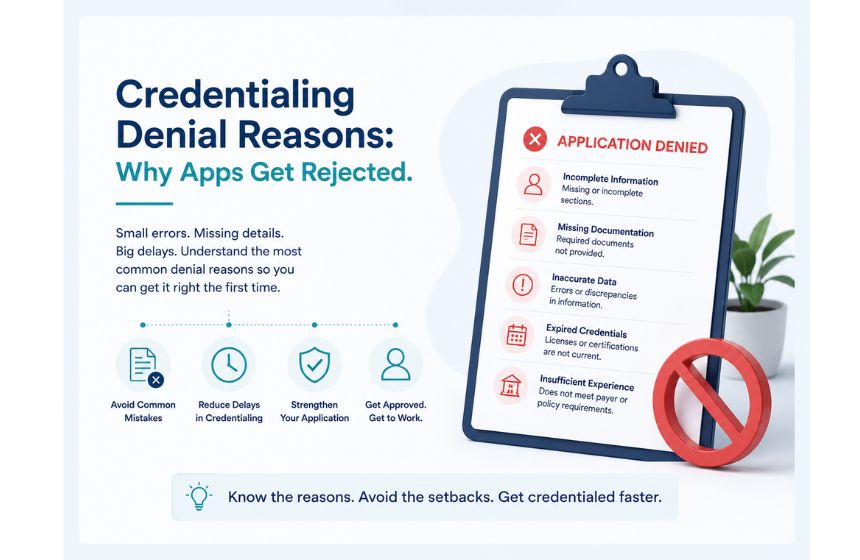
The Most Common Credentialing Denial Reasons
The patterns below come from analyzing thousands of credentialing applications across commercial payers, Medicare, and Medicaid. In short, the overwhelming majority trace back to data mismatches, incomplete CAQH profiles, expired documents, and unexplained gaps. The patterns below are listed in rough order of frequency.
1. Data Mismatches Across NPPES, PECOS, and CAQH
The single most common credentialing denial reason in 2026 is data inconsistency between the three core systems: NPPES (the NPI registry), PECOS (Medicare enrollment), and CAQH (commercial credentialing). Payers cross-reference all three during verification. When they don’t match, the application stalls.
The typical mismatches:
- Name format differences (“John Q. Smith” in one system, “John Quincy Smith” in another)
- Practice address variations (Suite 200 vs. Ste. 200, Floor 3 vs. 3rd Floor)
- Different taxonomy codes between NPPES and the credentialing application
- Tax ID inconsistencies between PECOS and commercial applications
- Phone numbers or specialties that have updated in one system but not others
The fix: Before submitting any application, do a side-by-side audit of all three systems. The data should match exactly, character for character. Even differences in capitalization can trigger an automated rejection. When you update one system, update all three the same day.
2. Incomplete or Expired CAQH Profile
For commercial payer applications, CAQH is where the verification work happens. If the profile is incomplete, missing documents, or has an expired attestation, the credentialing application stalls regardless of how clean the application itself is.
The 120-day attestation window is the most common culprit. CAQH requires re-attestation every 120 days. When attestation lapses, payer access to the profile pauses. Applications mid-flight freeze. The full picture of how this works lives in our CAQH ProView guide, but for the purposes of denials: an expired CAQH attestation is one of the fastest ways to kill an application without realizing it.
The fix: Verify CAQH profile completeness and attestation status before submitting any commercial payer application. Build quarterly attestation reminders so it never lapses by surprise.
3. Expired Documents at Submission
Medical license, DEA registration, board certification, malpractice insurance certificate of insurance. If any of these expire during the credentialing window, the application is rejected.
The trap is timing. An application submitted in March with documents expiring in May will be reviewed in May or June. By the time the payer pulls the documents for verification, they’re expired. The application gets returned even though everything was current at submission.
The fix: Track every credentialing-relevant document expiration on a single calendar. Renew anything expiring within 90 days of an active application. For licenses, the 60-day buffer is critical because renewal processing time varies by state.
4. Work History Gaps That Aren’t Explained
Most payers require a complete five-year work history with no unexplained gaps longer than 30 days. Maternity leave, sabbaticals, research time, transitioning between practices — these are all acceptable, but they have to be explained in the gap field. Leaving a gap blank generates a development letter every time.
The fix: Review the work history section line by line before submission. Account for every gap explicitly. “Parental leave from June 2023 to September 2023” is a complete answer. Leaving the field blank or writing “personal” is not.
5. Wrong Taxonomy Code
The taxonomy code identifies a provider’s specialty and is the basis for how payers route applications, set reimbursement, and verify network appropriateness. A wrong taxonomy code, or one that doesn’t match across NPPES and the application, triggers automatic review.
The mistakes are usually subtle. A family medicine physician with a sports medicine specialty might use the wrong primary taxonomy. A behavioral health provider might use a generic mental health code when a specific specialty code applies. Multi-specialty providers often have to declare a primary taxonomy that may not match what they list elsewhere.
The fix: Use the NPPES NPI registry to verify the current taxonomy code on file, then match it exactly on the credentialing application. If you need to change taxonomy, update NPPES first and wait 48 hours before applying.
6. Underdisclosure on Background Questions
Credentialing applications include yes/no disclosure questions about malpractice claims, license actions, criminal history, hospital disciplinary actions, and DEA issues. The payer runs an NPDB query as part of primary source verification, which surfaces anything you didn’t disclose.
Answering “no” when the NPDB shows otherwise is treated as a credibility issue, not just an error. Even old, resolved cases that seem irrelevant need to be disclosed. The payer will discover them anyway, and the omission is worse than the underlying event for the application’s outcome.
The fix: Answer every disclosure question truthfully and completely. For yes answers, attach a written explanation with dates, outcomes, and current status. Most disclosures don’t actually disqualify a provider. Underdisclosure does.
7. Missing Primary Source Documentation
Some payers require specific documents uploaded directly: residency completion certificates, board certification copies, hospital affiliation letters, IRS W-9, malpractice declarations page. Missing any required document triggers a development letter.
The complication is that payers have different requirements. UnitedHealthcare’s required document list isn’t identical to Aetna’s, which isn’t identical to Cigna’s. Submitting the same packet to every payer without checking each one’s specific checklist leads to denials for “incomplete submission” even when the same packet was complete for a different payer.
The fix: Maintain a payer-specific document checklist. Before submission, verify every required document for that payer is included, current, and legible.
8. Filing Errors on Supplemental Forms
Behavioral health providers, telehealth providers, and certain specialties (anesthesiology, pathology, radiology) often have payer-specific supplemental forms beyond the standard application. These forms ask for service modalities, group affiliations, hospital privileges, or telehealth platform information. Missing or incorrectly completed supplemental forms are a frequent cause of denial for these specialties.
The fix: Before submitting, ask the payer’s credentialing contact directly whether any supplemental forms apply to your specialty. Don’t assume the standard application packet is sufficient.
9. Filing During Peak Credentialing Seasons
This isn’t strictly a denial reason, but it dramatically increases the chance of one. January and July are peak credentialing seasons because of new physician onboarding cycles. November and December see committee schedules thin out due to holidays. Applications filed in peak periods are reviewed by overwhelmed teams, which increases the chance of clerical errors being caught only late in the process.
The fix: Where possible, target submissions for March through May or September through October. Volume is lower, response times are faster, and the chance of clean processing is higher.
Is credentialing holding up your revenue?
Every day a provider sits uncredentialed is a day you can’t bill for their work. We take the whole process off your plate.
We handle all of it. Flat $150 per application, all 50 states, with clear status on every provider.
Get My Providers Credentialed → or call (307) 243 2190How to Fix a Denial You’ve Already Received
To fix a denial, read the notice carefully, respond within 48 hours, and supplement the existing application rather than starting over. The exact approach depends on what the payer is asking for.
Read the development letter or denial notice carefully. Most practices skim, identify the obvious issue, and respond. Then they get a second letter pointing out the issue they missed. The first read should be deliberate: what is the payer actually asking for, what supporting documentation do they need, and what’s the response deadline?
Respond within 48 hours where possible. Payers expect responses within 30 days, but the longer you wait, the longer the application sits in the queue. A response sent 24 hours after receipt gets back into active review faster than one sent three weeks later. Speed matters more than people realize.
Supplement, don’t restart. Unless the payer specifically asks for a new application, respond to the existing one. Starting over moves you to the back of the queue. Supplementing keeps your place in line.
Escalate when stuck. If a payer is unresponsive or the issue isn’t resolving, ask to speak with a credentialing supervisor. For Medicare denials, the CMS Provider Enrollment Hotline and CMS ombudsman are available. For commercial payer disputes that aren’t resolving, state insurance commissioners can be a useful escalation point.
Document everything. Date, name, phone number, what was said, what the next step was supposed to be. If a denial turns into an extended dispute, the paper trail matters.
How to Prevent the Next One
The credentialing denial reasons above are recurring patterns, which means they’re preventable with a small set of habits.
Pre-submission checklist. Before any application goes out, run through a fixed checklist: data alignment across NPPES, PECOS, and CAQH; document expiration dates within active window; CAQH attestation current; payer-specific supplemental forms identified; disclosures complete with attached explanations where needed.
Quarterly CAQH attestation. Build attestation into a calendar with reminders at day 90 and day 105 of each cycle. For group practices, stagger provider attestation dates so the work doesn’t pile up in one week.
Document expiration tracking. A single calendar for all credentialing-relevant document expirations: medical license, DEA, CDS, malpractice COI, board certification. 60-day advance reminders for everything.
Cross-system audit. Quarterly, verify that NPPES, PECOS, CAQH, and internal records all show the same name, address, taxonomy, and tax ID. Drift between systems is one of the most predictable sources of denial reasons, and it’s almost completely preventable.
One owner. Distributed credentialing responsibility is where most denial patterns originate. One person should own the calendar, the submissions, the follow-ups, and the system audits. Whether that’s internal or outsourced, the accountability has to be clear.
The 90-day credentialing timeline walks through where each of these checks fits into the normal application flow. Practices that build the habits into the timeline rather than chasing them after a denial almost never see repeated rejections.
When the Problem Is Systemic, Not One Application
A single denial is usually a one-off mistake. Two denials in six months might still be coincidence. Three or more denials in a six-month period is almost never bad luck. It means something in the credentialing process is structurally broken, and continuing to submit applications without fixing it produces the same outcome each time.
The structural issues are usually one of three things: distributed ownership without accountability, inconsistent data hygiene across systems, or a knowledge gap about payer-specific requirements. None of these get fixed by submitting another application. They get fixed by stepping back and auditing the process.
Recent industry analysis shows 61% of practices have at least one active credentialing lapse at any given time, and 78% of those lapses go undetected for 60 or more days. Most practices learn about the problem from denied claims, not proactive monitoring. By then, weeks of revenue are already lost.
If denials are a pattern in your practice, the free CredReady audit reviews your current credentialing posture across all major payers, flags data mismatches and expiration risks, and identifies the structural cause of repeated denial reasons. It takes 15 minutes and produces a personalized PDF showing exactly where the gaps are.
Frequently Asked Questions
Most credentialing denials come from a small set of recurring issues: data mismatches across NPPES, PECOS, and CAQH; incomplete or expired CAQH profiles; documents that expired during the review window; unexplained work history gaps; wrong taxonomy codes; and underdisclosure on background questions. The provider is usually qualified. The application just had a fixable error.
A formal denial is a payer’s final rejection and is relatively rare for qualified providers. A returned application has been sent back for correction because something was incomplete or inconsistent. A development letter is a request for additional information while the application is still under review. Most credentialing rejections are returns or development letters, not formal denials, which means they’re fixable.
Each round of correction typically adds two to four weeks to the timeline. A clean application that would have approved in 60 days can stretch to 90 to 120 days after one returned correction, and 150 days after two. Responding to a development letter within 48 hours rather than waiting weeks is the single biggest factor in how fast a denial resolves.
Yes. Formal denials have a structured appeals process, and many denials are overturned because they were soft denials dependent on documentation gaps. For returned applications and development letters, you don’t appeal, you supplement the existing application with the requested information. Starting a new application instead of supplementing moves you to the back of the queue.
Run a pre-submission checklist that confirms data alignment across NPPES, PECOS, and CAQH, current document expiration dates, a current CAQH attestation, complete disclosures, and any payer-specific supplemental forms. Most denials are preventable by submitting a clean, consistent application the first time rather than fixing errors after the fact.
Stop Losing Weeks to Credentialing Denials
Most credentialing denial reasons are preventable. The eight or nine recurring causes above account for the vast majority of rejections, and each one has a specific fix. The issue isn’t usually skill — it’s having the bandwidth to maintain clean data, track expirations, and respond fast when something needs clarification.
MedBillingTech handles credentialing for solo providers, group practices, and telehealth networks across all 50 states. Flat fee of $150 per application with primary source documentation, payer follow-up, and denial response management included. Sixteen-plus years of payer enrollment experience.
Get Started With Credentialing →
Or call (307) 243 2190 to talk through what’s happening with a specific denied application.