If you’ve ever wondered why a credentialing application sits in “pending” for weeks while you have no idea what the payer is waiting for, the answer is almost always somewhere inside your CAQH ProView profile. For commercial payers, CAQH is the first stop. Your application is the formal request. Your profile is what they actually verify against.
Most new providers find out about CAQH the same way: someone tells them they need an account, they create one, they fill in the obvious fields, and they assume they’re done. Six weeks later, an application stalls at a payer they thought they applied to last month. The payer support line eventually explains that the profile isn’t authorizing access, or the attestation is expired, or a field doesn’t match the application. By the time it’s fixed, three weeks of waiting time has evaporated.
CAQH isn’t complicated, but the way it interacts with payer credentialing is non-obvious. This is what it actually does, what breaks it, and how to maintain it so it stops being the silent reason your applications take longer than they should.
What CAQH ProView Actually Is
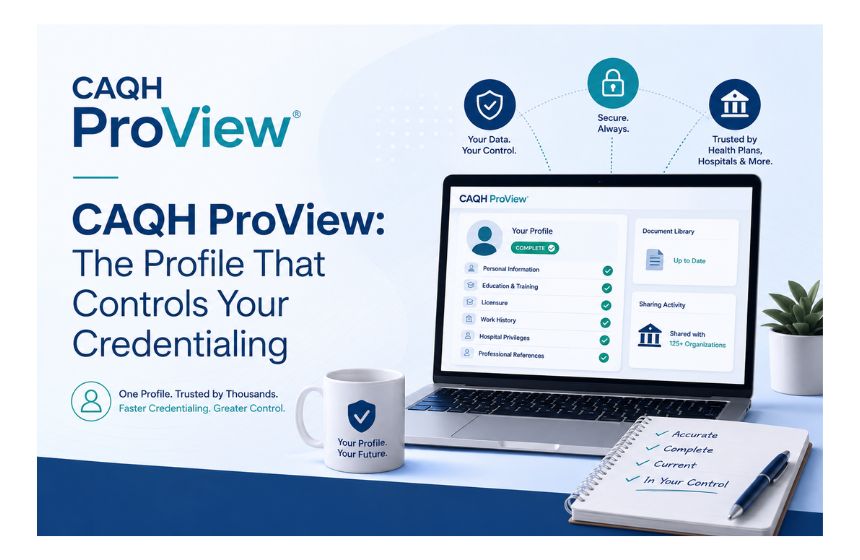
CAQH ProView is a centralized credentialing database that commercial payers query to verify your qualifications, run by the Council for Affordable Quality Healthcare, a non-profit alliance of health plans and trade associations. The point of the system is to eliminate the duplicate work that used to happen when every payer ran its own credentialing process from scratch. Instead of filling out separate applications for ten different payers with mostly the same information, providers maintain one profile in CAQH, and payers query that profile when they need to credential or re-credential. CAQH is one of three core systems in the provider credentialing process, alongside NPPES and Medicare’s PECOS.
The system holds profiles for more than 2.5 million providers, and most major U.S. health plans use it as their primary source of credentialing data. When you submit an application to UnitedHealthcare, Aetna, BCBS, Cigna, Humana, or almost any commercial payer that pursues NCQA accreditation, the payer is checking your CAQH profile before they look at anything else.
What this means in practice: the payer application is the trigger. The CAQH profile is the data. If those two disagree, the application stalls. If the profile is incomplete, the application stalls. If you forgot to authorize the payer to access your profile, the application stalls without anyone telling you why.
It is worth being precise about what CAQH is not. It is not a payer. It does not approve or deny applications. It does not enroll you in any network. It is a database, and its role in credentialing is data delivery. The actual credentialing decision happens at the payer level. CAQH is the layer in between that determines how cleanly that decision gets made.
How Payers Actually Use the Profile
When a payer initiates credentialing for a provider, they query CAQH for the provider’s record. That query returns license data, education and training history, work history, malpractice coverage, sanctions disclosures, DEA and CDS information, hospital affiliations, board certifications, and the provider’s attestation that all of the above is accurate as of a specific date.
The payer then does primary source verification against the data in the profile, calling licensing boards, querying the National Practitioner Data Bank, contacting previous employers, confirming education with the medical school. If the data verifies cleanly, the application moves to committee review. If anything doesn’t verify, the payer sends a development letter asking for clarification or additional documentation.
Roughly 80% of what a typical commercial payer verifies comes directly from the CAQH profile. The remaining 20% comes from supplemental forms specific to that payer, behavioral health questionnaires, or specialty-specific requirements. The 80% is what determines whether the process moves fast or slow.
The Fields That Matter Most
A handful of profile sections cause most of the delays, so those are the ones worth getting exactly right. The profile has many sections, but these disproportionately determine whether your credentialing moves smoothly.
Personal information. Name (legal name as it appears on your license), date of birth, Social Security number, NPI number. The name field is the most common source of mismatches. If your license reads “John Q. Smith” and your CAQH profile reads “John Quincy Smith,” primary source verification flags the discrepancy and the application pauses. Match the license exactly, including middle initials, suffixes, and any other formatting quirks.
Education and training. Medical school, residency, fellowship, with dates and program directors. The dates have to match what the school will confirm during primary source verification. Off-by-one-year mistakes here are surprisingly common and surprisingly painful.
Work history. Five years minimum, no gaps. Any gap longer than 30 days needs an explanation in the gap field. “Maternity leave,” “research sabbatical,” “transitioning between practices” all work. What does not work is leaving a gap unexplained. Unexplained gaps generate development letters every time.
Licensure. Active medical license number, state, issue date, expiration date. If the license is up for renewal during the credentialing window, the payer will hold the application until the new license number is in the profile. Build a calendar reminder for license renewal at 60 days out, not 30.
DEA and CDS. Federal DEA registration, state controlled dangerous substances registration where applicable. Expirations here also pause applications.
Malpractice insurance. Carrier name, policy number, effective and expiration dates, per-claim and aggregate limits, claims history. Most payers require a Certificate of Insurance uploaded directly to the profile. The COI has to be current. An expired COI freezes the profile for commercial payer access even if the policy itself is still in force.
Hospital affiliations. Current and past hospital privileges with dates. If a privilege ended for any reason other than voluntary resignation, expect a follow-up question.
Disclosure questions. Yes/no questions about malpractice claims, license actions, criminal history, hospital disciplinary actions. Answering yes to any of these is not disqualifying, but it is verification-required. The disclosure has to match what shows up in the National Practitioner Data Bank query the payer runs. Underdisclosure here is the single fastest way to torpedo an application.
Authorization to specific payers. This is the field most providers miss. A complete profile is not visible to a payer until you explicitly authorize that payer to access it. You can have a perfect profile and submit an application that never gets reviewed because the payer can’t see your data. Authorization is per-payer and has to be done inside the CAQH portal for each plan you intend to participate with.
The 120-Day Attestation Rule
An expired attestation is the single most common reason CAQH-dependent credentialing stalls, and it’s also the most preventable. This is the rule that breaks more credentialing programs than any other.
CAQH requires providers to re-attest to the accuracy of their profile every 120 days, with one exception: providers practicing in Illinois attest every 180 days instead. Attestation is a literal action: you log into the profile, confirm that all data is current and accurate, and electronically sign. When attestation expires, the profile is marked as outdated, and commercial payer access pauses. Applications in progress freeze. Re-credentialing cycles stall. Any payer that queries the profile while it’s in lapsed-attestation status will not be able to retrieve the data.
The painful part is that nothing breaks loudly when attestation expires. Claims continue to process for already-enrolled payers. Patients continue to be scheduled. The only thing that quietly stops working is forward motion on new applications and renewals. Practices often discover the lapse weeks later when a credentialing specialist calls to ask why an application is stuck.
The fix is calendar discipline. Set a reminder at day 90 of every cycle and another at day 105. For group practices with multiple providers, stagger the dates so attestations aren’t all due in the same week. Some practices delegate attestation reminders to a credentialing coordinator who logs into each provider’s profile on a fixed schedule. Whatever the system is, it has to exist. Trusting providers to remember on their own is how attestations expire.
Is credentialing holding up your revenue?
Every day a provider sits uncredentialed is a day you can’t bill for their work. We take the whole process off your plate.
We handle all of it. Flat $150 per application, all 50 states, with clear status on every provider.
Get My Providers Credentialed → or call (307) 243 2190The Mistakes That Cause Most Delays
Most CAQH-driven delays come from a small set of recurring mistakes, and every one of them is preventable. Across thousands of credentialing cycles, these account for the bulk of avoidable delay.
Profile data that doesn’t match the application. When the formal payer application says one thing and CAQH says another, the payer reconciles by sending a development letter. Every development letter adds two to four weeks to the timeline. The fix is to use CAQH as the source of truth and copy data from it into any payer-specific supplemental forms, not the other way around.
Attestation lapses. Covered above. The 120-day cycle is short enough that any disruption in routine causes it to be missed.
Missing payer authorization. A clean, attested profile that hasn’t been authorized to the specific payer you applied with might as well not exist. Build payer authorization into your application checklist as a separate, explicit step.
Document expirations. Malpractice COI, DEA, license, board certification. CAQH does not auto-renew these. When a document expires, the field shows expired and any payer trying to verify it will pause. Track document expirations on a calendar that’s separate from the attestation calendar.
Disclosure inconsistencies. A “no” disclosure on a malpractice question that contradicts what the NPDB shows is an automatic flag. Even old, resolved cases that you might think aren’t worth disclosing need to be disclosed. The NPDB query will surface them, and the payer will treat the omission as a credibility issue.
Address mismatches with NPPES and PECOS. CAQH, NPPES, and PECOS should show the same primary practice address. When they don’t, automated cross-checks flag the discrepancy and payers ask for clarification. Reconcile all three systems whenever you change practice locations.
Profile abandonment after initial credentialing. Providers get credentialed, the profile served its purpose, and they stop logging in. Two cycles later, attestation has lapsed, documents have expired, and the next re-credentialing cycle requires what feels like a full profile rebuild.
A Maintenance Routine That Actually Holds Up
The practices that don’t get tripped up by CAQH share a small set of habits.
Quarterly attestation. Treat re-attestation as a fixed quarterly task. Same day every quarter, on someone’s calendar, with a backup reminder for the credentialing coordinator. Provider attests on schedule whether or not anything in the profile has changed.
Annual full profile review. Once a year, walk through every section of the profile. Verify that work history is current. Confirm that hospital affiliations reflect actual current privileges. Re-upload current malpractice COI. Update license expiration dates. The annual review catches drift that the quarterly attestation misses because attestation is a check-the-box action, not a full audit.
Document expiration tracking. Maintain a calendar of all credentialing-relevant document expirations: medical license, DEA, CDS, malpractice COI, board certification. Set reminders 60 days before each expiration. The 60-day buffer is enough to renew and upload without lapse.
Payer authorization audit. When you add a new payer, the authorization step is explicit in the application checklist. When you drop a payer, you can leave the authorization in place (there’s no harm in extra authorizations), but the active payer list should be reviewed annually to confirm it matches reality.
Single source of truth for credentialing data. Whatever changes go into CAQH should also go into NPPES, PECOS, and your internal records on the same day. The discipline of updating everything together prevents the slow drift that creates mismatches months later.
Where CAQH Fits in the Larger Credentialing Picture
CAQH is one piece of a credentialing program that also includes Medicare PECOS, state Medicaid systems, and direct payer portals. For most practices, CAQH is the most-touched of these because commercial payer credentialing happens far more frequently than Medicare revalidation or Medicaid renewal. If you understand what CAQH is doing in the background, the 90-day credentialing timeline becomes much more navigable, and the re-credentialing cycles become much easier to manage.
CAQH is also the place where credentialing problems often hide. A practice that thinks credentialing is fine because claims are paying may have a CAQH profile that’s quietly lapsed, blocking new applications and renewals that nobody is actively chasing. This is the failure mode that a credentialing audit catches before it becomes a revenue problem.
When to Maintain It Yourself, When to Hand It Off
For a solo provider with two or three commercial payers, CAQH maintenance is a quarterly task that takes maybe an hour per cycle. The math gets harder for group practices. Twelve providers means twelve profiles, twelve attestation calendars, twelve sets of document expirations, and dozens of payer authorizations to track. At that scale, the work is enough to consume meaningful staff time and produce errors when it gets squeezed by other priorities.
Practices that outsource credentialing typically outsource CAQH maintenance with it. The vendor maintains the profile, tracks attestations, monitors document expirations, and handles payer authorizations. The work happens whether or not the provider remembers, which is the entire point.
Frequently Asked Questions
CAQH ProView is a centralized online database where healthcare providers maintain a single credentialing profile that commercial payers use to verify their qualifications. Instead of completing separate applications for every insurer, providers keep one profile current, and payers like UnitedHealthcare, Aetna, BCBS, Cigna, and Humana pull from it during credentialing and re-credentialing.
Yes. CAQH ProView is free for providers to create and maintain. The cost of the system is covered by the participating health plans that use it, not by the providers who maintain profiles. Providers only invest time, not money, in keeping the profile current.
Every 120 days for providers in most states, or every 180 days for providers practicing in Illinois. CAQH requires providers to log in, confirm that all profile data is accurate, and electronically re-attest on that cycle. If attestation lapses, commercial payers lose access to the profile, which freezes any credentialing or re-credentialing applications in progress until you re-attest.
The most common reason is that you haven’t authorized that specific payer to access your profile. A complete, attested CAQH profile is still invisible to a payer until you grant that payer access inside the CAQH portal. Authorization is done separately for each plan you intend to participate with.
When attestation expires, your profile is marked outdated and commercial payers can no longer retrieve your data. New applications stall, re-credentialing cycles freeze, and nothing visibly breaks for already-enrolled payers, so the lapse often goes unnoticed until someone asks why an application is stuck. Re-attesting restores access immediately.
A Lapsed CAQH Profile Is Costing You Revenue You Don’t Know About
CAQH is the layer where credentialing problems most often hide. Profiles drift, attestations lapse, documents expire, and payers quietly stop processing your applications. The first sign for most practices is a denied claim. By then, the damage is already done.
MedBillingTech maintains CAQH profiles as part of our credentialing service, flat fee $150 per application. Quarterly attestation tracking, document expiration management, payer authorization audits, and primary source coordination included. Sixteen-plus years of payer enrollment experience across all 50 states.
If you want to find out where your credentialing currently stands before deciding what to do about it, the free CredReady audit covers CAQH posture, payer enrollment gaps, and document status in 15 minutes. No obligation, no pitch if you don’t need help.
Or call (307) 243 2190 to talk through where your CAQH profile sits today.